
Mathematics is not simply a subject of numbers and formulas; it is a discipline that develops logical reasoning, accuracy, problem-solving ability, and critical thinking. Yet many students lose marks not because they lack mathematical ability, but because of avoidable mistakes made while reading, planning, calculating, or presenting their solutions. Understanding these mistakes is an important part of error analysis, because an error can reveal exactly where learning has broken down.
Recent research continues to show that students’ mathematical errors are often connected to conceptual understanding, problem interpretation, transformation, calculation, and failure to check final answers. Studies using frameworks such as Newman’s Error Analysis identify errors at stages ranging from reading and comprehension to mathematical processing and writing the final answer.
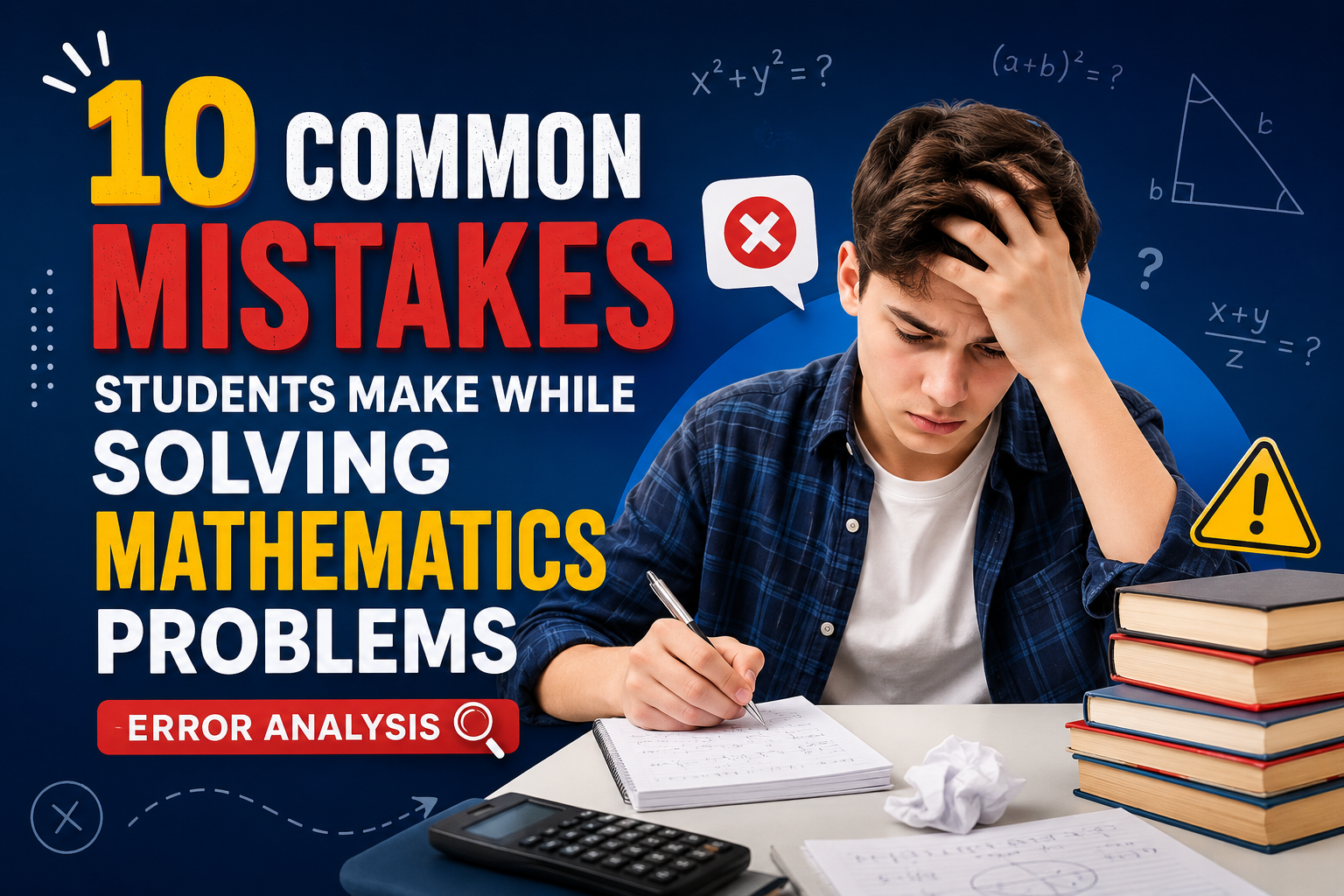
Here are ten common mistakes and ways students can overcome them.
1. Not Reading the Problem Carefully
One of the most common mistakes is beginning calculations before fully understanding the question. Students may overlook important words, units, conditions, or information.
For example, a problem may ask for the total cost after a discount, but a student may calculate only the discount amount. The calculation itself may be correct, but it does not answer the actual question.
Solution: Read the problem at least twice. Identify what is given, what is required, and what information is relevant.
2. Misunderstanding Mathematical Concepts
Students sometimes memorize formulas without understanding what they represent. This becomes a serious problem when a question is presented in an unfamiliar form.
Recent research has found that conceptual and application errors can be particularly important when students struggle with mathematical problem solving.
For example, a student may remember the formula for the area of a triangle but be unable to determine which measurement represents the height.
Solution: Before using a formula, ask: What does this formula mean? Why is it appropriate for this problem?
3. Choosing the Wrong Formula or Method
Another common error occurs when students recognize a familiar topic but select an inappropriate formula or procedure. This often happens when several formulas look similar.
For instance, students may confuse formulas for area, perimeter, surface area, or volume.
Solution: Do not choose a formula simply because it looks familiar. First identify the mathematical relationship involved in the problem.
4. Making Basic Calculation Errors
Even when the concept and method are correct, a simple arithmetic mistake can produce an incorrect answer. Common examples include incorrect addition, subtraction, multiplication, division, or handling of negative numbers.
Research on student errors continues to identify calculation and process-skill mistakes as recurring problems.
Solution: Perform calculations carefully and use estimation to check whether the answer is reasonable.
5. Ignoring Units
Students often calculate correctly but forget to include or convert units. This is especially common in questions involving length, area, volume, speed, time, money, and measurement.
For example, mixing metres and centimetres without conversion can lead to an incorrect result.
Solution: Write the units beside the numbers throughout the solution and check them before giving the final answer.
6. Skipping Steps
Some students try to solve problems mentally or write only the final calculation. While this may appear faster, it makes errors difficult to identify and correct.
Writing clear steps helps students organize their thinking and allows teachers to understand where a mistake occurred.
Solution: Show important stages of the solution, especially when solving multi-step problems. A clear solution is evidence of clear mathematical thinking.
7. Struggling to Translate Word Problems into Mathematics
Word problems require students to transform ordinary language into mathematical expressions, equations, diagrams, or models. This is often more difficult than performing the calculation itself.
Recent research has found that students can struggle with comprehension and transformation when solving contextual mathematics problems.
Solution: Underline important information, identify unknown quantities, draw a diagram when appropriate, and translate the problem into mathematical language step by step.
8. Using a Familiar Procedure Without Thinking
Students sometimes learn a particular procedure and apply it automatically, even when the problem requires a different strategy. This is a form of procedural dependence.
For example, seeing a fraction problem and immediately searching for a memorized rule may lead to an incorrect method.
Solution: Pause before calculating. Ask, What is the problem really asking? What mathematical idea is involved? Is there another possible approach?
9. Failing to Check the Answer
Many students stop immediately after obtaining a numerical answer. However, a correct mathematical solution should also make sense in context.
Recent studies have identified rechecking and final-answer stages as important areas of difficulty for students.
Solution: Develop a “final check” habit. Ask:
- Does the answer make sense?
- Did I answer what was asked?
- Are the units correct?
- Can I verify the answer using another method?
- Did I make a sign or calculation error?
10. Giving Up When the Problem Looks Difficult
Perhaps the most damaging mistake is believing that a difficult problem cannot be solved. Students may become anxious when they do not immediately recognize a method.
However, mathematical problem solving often requires exploration, trial, revision, and persistence. Recent research on mathematical problem solving also emphasizes the importance of exploration and identifies analysis errors when students move into solving without adequately exploring the problem.
Solution: Break a difficult problem into smaller parts. Write down what you know, draw a diagram, look for patterns, estimate possible answers, and try a simpler related problem.
Current Situation: Error Analysis in the Digital Age
The way students learn mathematics is changing rapidly. Online resources, calculators, educational applications, and AI tools can now provide mathematical solutions almost instantly. These technologies can be valuable for explanations, visualization, practice, and feedback. However, they also create a new challenge: students may obtain an answer without understanding the reasoning behind it.
The OECD’s current PISA framework places increasing emphasis on students’ ability to learn and solve problems in digital environments through iterative, self-regulated processes, including identifying and correcting errors through feedback.
Therefore, students should not use technology simply to avoid mistakes. Instead, they should use it to identify, understand, and correct mistakes. A student who asks an AI tool, “Why is my method incorrect?” can potentially learn much more than a student who simply asks, “What is the answer?”
Turning Mistakes into Learning Opportunities
Error analysis should not be used merely to count how many questions students got wrong. Its real purpose is to discover why the error happened. Was it a reading mistake, a conceptual misunderstanding, a wrong strategy, a calculation error, or a failure to communicate the final answer?
Recent research suggests that structured error analysis can support problem-solving ability, metacognition, and conceptual understanding, although students may need guidance to analyze and explain their own errors effectively.
Teachers can therefore encourage students to maintain a “Mathematics Mistake Journal.” After each exercise, students can record the problem, their incorrect approach, the correct reasoning, and the lesson they learned. Over time, repeated patterns become visible, allowing students to focus on their actual weaknesses.
Conclusion
Mathematical mistakes are not simply signs of failure; they are valuable information about how a student thinks. The ten common mistakes discussed above—misreading questions, misunderstanding concepts, choosing the wrong method, making calculation errors, ignoring units, skipping steps, misinterpreting word problems, applying procedures mechanically, failing to check answers, and giving up too quickly—can all be reduced through careful practice and reflection.
In today’s technology-rich educational environment, the goal should not be to eliminate every mistake immediately. Instead, students should learn to recognize, analyze, explain, and correct their mistakes. Mathematics becomes much more meaningful when students understand not only how to find the right answer, but also why their previous answer was wrong. Ultimately, the best mathematics students are not those who never make mistakes. They are those who learn from every mistake and use it to become better problem solvers.