

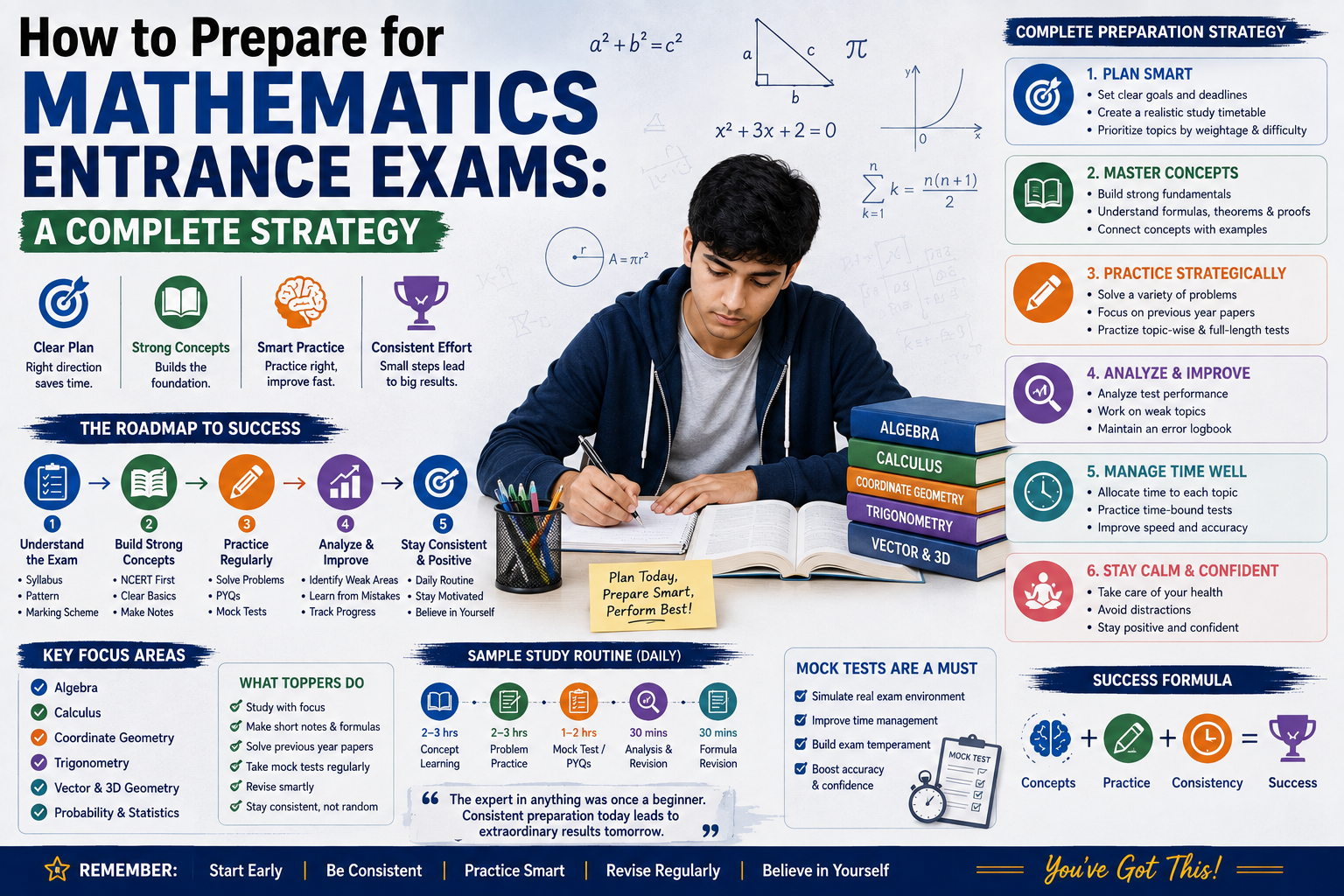
Mathematics entrance examinations are designed to test much more than a student’s ability to remember formulas. They measure conceptual understanding, logical reasoning, problem-solving speed, accuracy, and the ability to remain calm under pressure. Whether the examination is for secondary school, university admission, scholarship selection, or a competitive academic program, effective preparation requires a clear strategy rather than simply studying for long hours.
In the current competitive educational environment, students have access to textbooks, online classes, video lessons, practice platforms, calculators, and artificial intelligence tools. These resources can make preparation more flexible, but they can also create information overload. The most successful preparation strategy is therefore not to use every available resource, but to use the right resources systematically and consistently.
1. Understand the Examination Before Studying
The first step is to understand the examination itself. Students should carefully examine the syllabus, question format, marking scheme, duration, difficulty level, and topics that carry significant weight.
Collect previous years’ question papers and analyze them. Identify frequently repeated concepts, common question patterns, and topics where mistakes are most likely. This creates a realistic study plan and prevents students from spending excessive time on low-priority areas.
A simple principle is:
Know the exam → Identify your weaknesses → Build a targeted plan → Practice → Analyze → Improve.
2. Build a Strong Conceptual Foundation
Entrance examinations often include questions that look different from textbook examples. Students who depend only on memorized formulas may struggle when a problem requires a new approach.
Begin with fundamental concepts such as algebra, arithmetic, geometry, trigonometry, functions, probability, statistics, or calculus, depending on the examination level. Understand the meaning behind formulas and learn when each formula should be applied.
For every important concept, ask:
- What does it mean?
- Why does the formula work?
- When should I use it?
- Can the problem be solved another way?
- What happens if one condition changes?
Conceptual understanding improves both accuracy and flexibility.
3. Create a Realistic Study Schedule
Long study hours do not automatically produce better results. A realistic and consistent schedule is more effective.
Students can divide their preparation into three stages:
Foundation stage: Learn and revise concepts.
Practice stage: Solve topic-based and mixed questions.
Mock-test stage: Simulate the actual examination and analyze performance.
Daily study can include concept revision, problem solving, error analysis, and short revision sessions. Difficult topics should receive more attention, but stronger topics should also be reviewed regularly.
4. Practice for Both Accuracy and Speed
Entrance examinations usually involve time pressure. A student may understand a question perfectly but still lose marks by spending too much time on it.
Start by solving problems slowly and accurately. Once the method becomes familiar, gradually introduce time limits. Learn to identify which questions can be solved quickly and which require deeper thinking.
A useful strategy during the examination is to divide questions into three categories:
Easy: Solve immediately.
Moderate: Return after completing easy questions.
Difficult: Attempt only when sufficient time remains.
This prevents one difficult question from consuming valuable examination time.
5. Solve Previous Questions and Mock Tests
Past papers are among the most valuable preparation tools because they reveal the style and level of the examination. Students should not merely solve them; they should analyze them.
After each practice test, record:
- Questions answered incorrectly
- Questions guessed correctly
- Questions that took too much time
- Concepts that were forgotten
- Calculation mistakes
- Questions left unanswered
A mock test is useful only when the student learns from its results.
6. Maintain a Mathematics Error Journal
One of the most effective entrance-preparation techniques is keeping an error journal. Every significant mistake should be recorded with its cause.
For example:
| Mistake | Possible Cause | Corrective Action |
| Wrong formula | Concept not understood | Revise concept |
| Calculation error | Carelessness | Slow down and check |
| Question misunderstood | Poor reading | Underline key information |
| Too much time spent | Inefficient method | Learn alternative strategy |
Review this journal every week. Repeated mistakes are warning signs that require additional practice.
7. Use Technology and AI Wisely
The current learning environment offers students powerful digital resources. Online lectures, question banks, interactive mathematics applications, calculators, and AI-based tutors can provide explanations and additional practice.
However, technology should support learning rather than replace thinking. Students should first attempt a question independently. If they are stuck, they can use technology for a hint or explanation and then solve the problem again without assistance.
AI is particularly useful for asking questions such as:
“Explain where my reasoning went wrong.”
This is more educational than simply asking:
“Give me the answer.”
The ability to verify AI-generated solutions is also important because automated tools can sometimes produce incorrect or misleading explanations.
8. Develop Mental Discipline
Entrance examinations test psychological endurance as well as mathematical knowledge. Anxiety, overthinking, and fear of difficult questions can negatively affect performance.
Students should develop a calm examination routine. Practice under realistic conditions: sit at a desk, follow the actual time limit, avoid unnecessary interruptions, and attempt the test without checking solutions.
Adequate sleep, regular physical activity, healthy meals, and short breaks also contribute to concentration. Studying continuously for many hours without rest can reduce attention and efficiency.
9. Revise Strategically Before the Exam
The final weeks should not be spent learning everything from the beginning. Focus on revision, frequently tested concepts, formulas, weak areas, and mistakes from previous tests.
Create short revision sheets containing important formulas, concepts, shortcuts, and common errors. However, do not turn revision into pure memorization. Each formula should be connected with its meaning and application.
During the final days, prioritize confidence and accuracy rather than attempting a large number of unfamiliar problems.
10. Develop an Examination-Day Strategy
Preparation does not end when students enter the examination hall. Read instructions carefully and manage time from the beginning.
Start with questions you understand. If a question appears unusually difficult, do not panic. Mark it and move forward. Return to difficult questions later.
Before submitting, use the remaining time to check calculations, signs, units, selected answers, and unanswered questions—especially where negative marking applies.
Current Situation and Future of Entrance Preparation
Entrance examinations are becoming increasingly competitive, while digital learning is making preparation more accessible. Students can now learn from teachers and resources beyond their geographical location. At the same time, the availability of instant answers through AI and online tools creates a risk of superficial learning.
The future of entrance preparation will therefore favor students who combine technology with independent reasoning. Memorizing large quantities of information is becoming less valuable than understanding concepts, recognizing patterns, interpreting unfamiliar problems, and making accurate decisions under pressure.
Conclusion
Successful mathematics entrance preparation is not about studying endlessly. It is about studying strategically, consistently, and intelligently. Understand the syllabus, strengthen concepts, practice regularly, develop speed and accuracy, solve previous papers, maintain an error journal, use technology responsibly, and take care of your mental and physical well-being.
The ultimate goal should not simply be to score well in one examination. Entrance preparation should develop the mathematical confidence, logical reasoning, discipline, and problem-solving ability that students will need throughout their academic and professional lives.Prepare with a plan, practice with purpose, learn from every mistake, and enter the examination with confidence.