

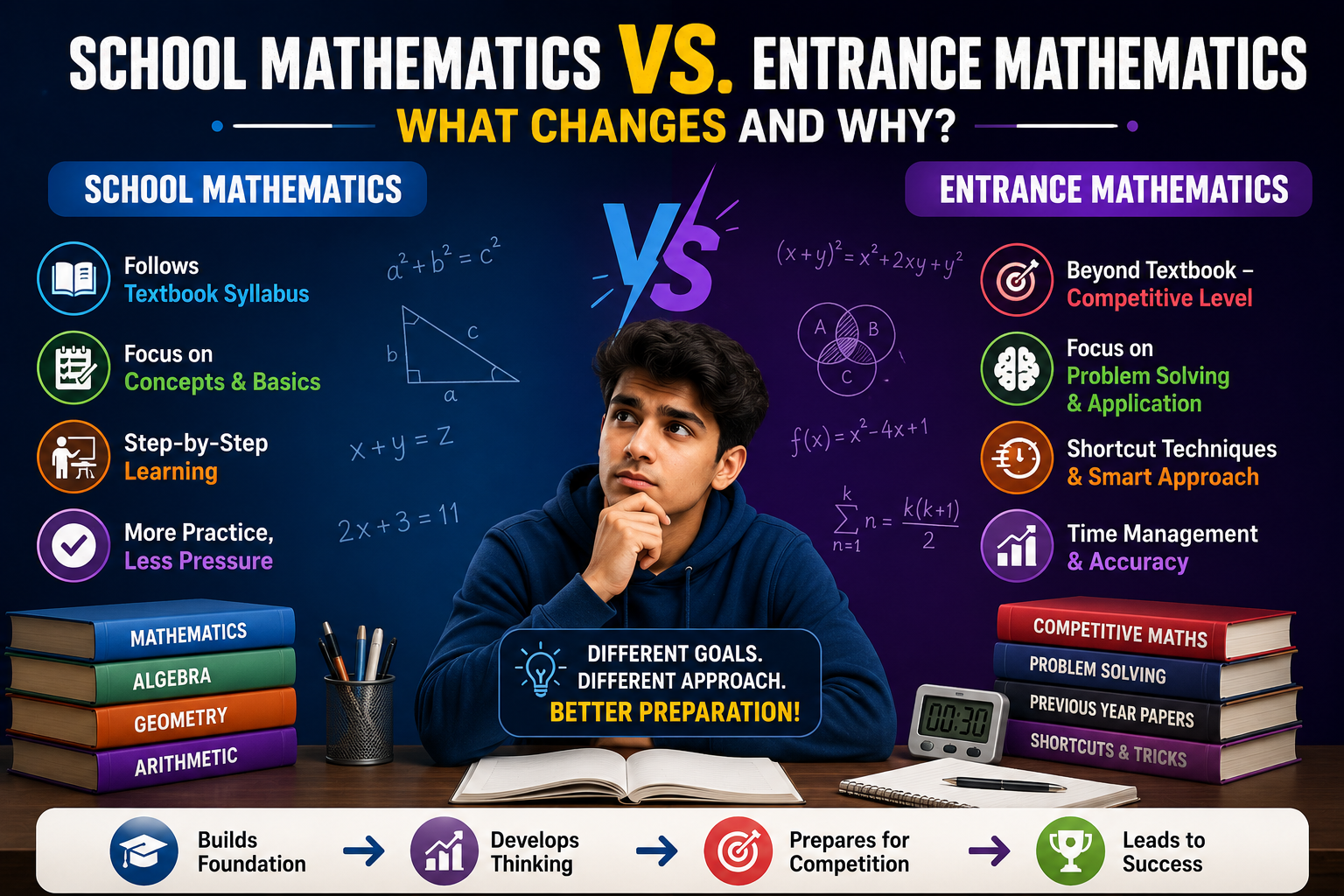
Mathematics remains an important part of both school education and entrance examinations, but the nature of mathematics changes significantly when students move from the classroom to competitive entrance tests. School mathematics primarily aims to build knowledge, concepts, and foundational skills, while entrance mathematics focuses more strongly on application, speed, accuracy, reasoning, and problem-solving under pressure. Understanding this difference is essential for students who want to make a successful transition from regular academic study to competitive examinations.
1. The Main Purpose Is Different
The first major difference lies in the purpose of learning.
School mathematics is designed to develop foundational mathematical knowledge. Students learn concepts systematically, usually according to a curriculum that progresses from basic to advanced topics. The emphasis is on understanding definitions, formulas, procedures, and standard problem-solving methods.
Entrance mathematics, however, is designed to differentiate among candidates. Questions may test whether students can apply familiar concepts to unfamiliar situations, recognize patterns quickly, and choose the most efficient method within a limited amount of time.
Thus, school mathematics asks, “Do you understand the concept?” while entrance mathematics often asks, “Can you apply the concept quickly and accurately?”
2. Familiar Questions vs. Unfamiliar Problems
In school, many exercises closely resemble worked examples. Students may learn a method in class and then solve several similar questions for practice.
Entrance examinations are often less predictable. A familiar concept may appear in an unfamiliar form. A question about algebra, geometry, probability, or arithmetic may require students to combine several ideas rather than apply a single formula.
For example, a school question might directly ask students to calculate the area of a triangle when its base and height are given. An entrance question could provide indirect information and require students to determine the missing height before calculating the area.
The mathematical concept is the same, but the thinking process is different.
3. Time Pressure Changes Everything
One of the most important differences is time.
In school mathematics, students usually have sufficient time to understand a problem, write several steps, and discuss their approach with a teacher. In entrance examinations, every minute matters.
A student may know how to solve a problem but still lose marks because the solution takes too long. Therefore, entrance preparation requires students to develop speed without sacrificing accuracy.
This does not mean rushing. Instead, students learn to recognize question types, select efficient methods, estimate answers, and decide when to skip a difficult problem temporarily.
4. Memorization vs. Flexible Understanding
School students often memorize formulas because formulas are necessary for building mathematical fluency. However, entrance mathematics demands more flexible understanding.
Students must know not only what a formula is, but also when and why it should be used. They should recognize relationships between different concepts and sometimes derive or transform formulas when necessary.
For example, knowing a standard algebraic identity is useful, but recognizing that the identity can simplify a complicated expression is a higher-level skill.
Therefore, entrance mathematics rewards conceptual understanding combined with strategic application.
5. One Method vs. Multiple Strategies
School exercises may sometimes encourage students to follow a particular procedure taught by the teacher. Entrance mathematics often rewards students who can identify the shortest reliable route to an answer.
A problem might be solved through algebra, geometry, estimation, logical reasoning, substitution, elimination, or pattern recognition. Experienced students learn to compare possible approaches and select the most efficient one.
This is why students preparing for entrance examinations should solve problems in multiple ways whenever possible. They gradually develop a personal collection of strategies rather than depending on a single method.
6. Accuracy Becomes More Important
In school examinations, students may receive partial credit for showing correct steps even if the final answer contains an error. In many entrance examinations, however, the final answer determines whether marks are awarded, and some tests may also penalize incorrect responses.
As a result, careless mistakes can become costly. Sign errors, incorrect units, misreading a question, arithmetic mistakes, or marking the wrong option can affect performance significantly.
Students therefore need a strong error-analysis habit. After practice tests, they should identify not only which questions were wrong but why they were wrong.
7. The Role of Practice Changes
School mathematics requires regular practice to build foundational skills. Entrance preparation requires deliberate and targeted practice.
Students should gradually move through three levels:
- Concept practice – understand the topic and solve basic questions.
- Application practice – solve unfamiliar and mixed problems.
- Timed practice – solve questions under realistic examination conditions.
Previous entrance papers and mock examinations become especially valuable because they help students understand question patterns and develop time-management skills.
8. Current Situation: Technology and AI
The current educational environment has introduced another major difference. Students now have access to online courses, digital question banks, video tutorials, calculators, and AI-based learning tools.
These resources can make preparation more accessible and personalized. Students can ask for explanations, generate additional practice questions, and receive immediate feedback.
However, easy access to answers creates a new challenge. If students use AI or online tools simply to obtain solutions, they may develop answer dependence rather than mathematical independence. For entrance preparation, students should first attempt problems themselves and then use technology to check reasoning, identify errors, or explore alternative methods.
The growing role of AI makes independent reasoning even more important because competitive examinations ultimately test what students themselves can understand and perform under examination conditions.
9. How Should Students Make the Transition?
Students should not completely abandon school mathematics when preparing for entrance examinations. Instead, they should build on it.
A strong transition strategy includes:
- Mastering school-level fundamentals.
- Identifying frequently tested entrance topics.
- Practicing unfamiliar problems.
- Developing mental calculation and estimation skills.
- Solving questions under time limits.
- Reviewing previous examination papers.
- Maintaining an error journal.
- Learning multiple problem-solving strategies.
- Taking regular mock tests.
- Using technology responsibly.
The key is to move gradually from learning concepts → applying concepts → solving efficiently under pressure.
Conclusion
The difference between school mathematics and entrance mathematics is not that they are two completely separate subjects. Rather, entrance mathematics represents a more demanding application of the mathematical foundation developed at school.
School mathematics builds the foundation, while entrance mathematics tests how effectively students can use that foundation. School learning emphasizes concepts and procedures; entrance preparation adds speed, flexibility, strategic thinking, accuracy, and pressure management.
In today’s competitive and technology-rich educational environment, students need more than memorized formulas. They need to understand mathematical ideas deeply, recognize patterns, select efficient strategies, learn from mistakes, and use digital tools intelligently. Ultimately, success in entrance mathematics comes from making a simple but important transition: from knowing mathematics to thinking mathematically under pressure.