

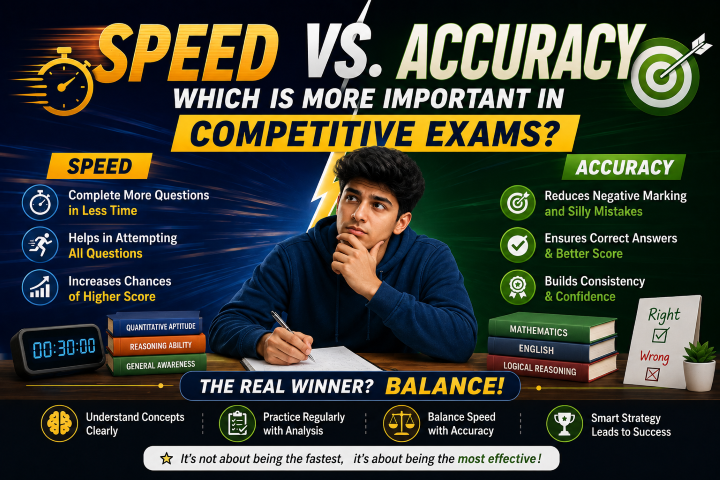
Competitive examinations are not only tests of knowledge; they are tests of how effectively students can use their knowledge under pressure. Among the many challenges candidates face, one question is especially important: Should you focus on speed or accuracy? The answer is neither speed nor accuracy alone. Successful performance requires the right balance between the two.
In a competitive examination, a student may know the correct method but lose marks because of slow work. Another student may solve questions very quickly but make careless mistakes. Therefore, the real goal is accurate speed—solving as many questions as possible correctly within the available time.
What Does Speed Mean in Competitive Exams?
Speed refers to the ability to understand, process, and solve questions within a limited amount of time. It includes reading questions quickly, identifying the correct method, performing calculations efficiently, and moving from one question to another without unnecessary delay.
Speed becomes particularly important when an examination contains many questions but provides limited time. A student who spends too long on one difficult problem may not have enough time to attempt easier questions later.
However, speed should never mean rushing blindly. Fast work without proper understanding can increase careless errors.
What Does Accuracy Mean?
Accuracy means producing the correct answer through valid reasoning and careful calculation. In many competitive examinations, accuracy is especially important because incorrect answers may result in lost marks, and some examinations include negative marking.
A student who answers 50 questions with 98% accuracy may perform better than someone who attempts 70 questions with only 65% accuracy. Therefore, the number of attempted questions alone does not determine success.
Accuracy comes from strong conceptual understanding, careful reading, proper calculation, and regular error analysis.
Why Accuracy Should Come First
During the early stages of preparation, students should prioritize accuracy over speed. There is little value in solving 30 questions quickly if half of the answers are wrong.
First, students should learn the concept and understand the correct procedure. They should practice without strict time pressure and focus on avoiding common errors. Once accuracy becomes consistent, speed can be developed gradually.
A useful progression is:
Understanding → Accuracy → Efficiency → Speed
Trying to reverse this order often creates bad habits.
Why Speed Still Matters
Accuracy alone is not enough in a time-limited examination. A student may solve every question correctly but still fail to complete the paper.
For example, imagine an examination with 100 questions and only 90 minutes. If a student spends five minutes on every difficult question, many easier questions may remain unanswered.
Competitive examinations therefore reward students who can quickly judge:
- Which questions are easy?
- Which questions require moderate effort?
- Which questions should be skipped temporarily?
- Which methods are fastest and safest?
This ability is called exam strategy, and it can significantly improve performance.
The Best Strategy: Accuracy First, Then Speed
Students should not think of speed and accuracy as enemies. They should develop them together through structured practice.
Stage 1: Learn Without Time Pressure
Begin by understanding the concept. Solve questions carefully and write complete steps. Identify mistakes and correct them.
Stage 2: Introduce Moderate Time Limits
Once accuracy becomes stable, start solving similar questions within a reasonable time. The goal is to become efficient without sacrificing correctness.
Stage 3: Practice Under Examination Conditions
Take complete mock tests using the actual time limit. Practice deciding when to attempt, skip, review, and move forward.
Stage 4: Analyze Performance
After every mock test, examine both speed and accuracy. Do not simply record the score.
Ask:
- How many questions did I attempt?
- How many were correct?
- How many were incorrect?
- Which questions consumed too much time?
- Which errors were avoidable?
- Which topics caused repeated problems?
This analysis turns practice into improvement.
Common Causes of Slow Performance
Students may be slow for several reasons. They may not understand the concept well enough, perform calculations inefficiently, reread questions repeatedly, or spend too much time on one difficult problem.
Another common reason is lack of familiarity. Regular exposure to different question types helps students recognize structures more quickly.
Mental calculation, estimation, basic algebraic manipulation, and familiarity with standard mathematical relationships can also improve efficiency.
Common Causes of Careless Mistakes
Speed can lead to errors when students rush through questions. Common mistakes include:
- Misreading the question
- Missing a negative sign
- Using the wrong formula
- Making arithmetic errors
- Forgetting units
- Selecting the wrong multiple-choice option
- Failing to check whether the answer is reasonable
The solution is not simply to “be more careful.” Students should identify their specific error patterns and practice eliminating them.
Current Situation: Technology and AI
The current education environment provides students with calculators, online practice platforms, video tutorials, digital question banks, and AI tools. These resources can improve preparation by providing instant feedback and additional practice.
However, technology can also create a false sense of speed. An AI tool can produce an answer instantly, but competitive examinations ultimately test the student’s own ability to reason and perform under time constraints.
Students should therefore use technology to improve conceptual understanding, error analysis, and timed practice, rather than depending on it to solve every problem.
AI can also be useful for generating practice questions at different difficulty levels or explaining why a student’s approach was incorrect. Used responsibly, it can support preparation without replacing independent thinking.
How to Improve Both Speed and Accuracy
A balanced preparation routine can include:
1. Daily calculation practice: Strengthen basic arithmetic and algebraic skills.
2. Timed question sets: Solve small groups of questions against the clock.
3. Error analysis: Record mistakes and identify their causes.
4. Mixed-topic practice: Avoid practicing only one topic at a time.
5. Mock examinations: Recreate real examination conditions regularly.
6. Skip-and-return strategy: Do not allow one difficult question to consume excessive time.
7. Final checking: Reserve a few minutes for reviewing doubtful answers.
The goal is not to become the fastest student in the room. It is to become the student who can make good decisions quickly and accurately.
Conclusion
So, which is more important in competitive examinations—speed or accuracy?
Accuracy is the foundation, while speed is the multiplier.
Without accuracy, speed simply produces more wrong answers. Without sufficient speed, accuracy may not translate into a high score because valuable questions remain unanswered.
The ideal competitive-exam student develops a balanced approach: understand concepts deeply, practice carefully, build accuracy first, gradually increase speed, analyze mistakes, and develop a smart examination strategy.
Ultimately, success is not about solving every question. It is about solving the right questions, in the right order, with the highest possible accuracy, within the available time.
Do not rush to become fast. Become accurate first—and then train yourself to become efficiently fast.