

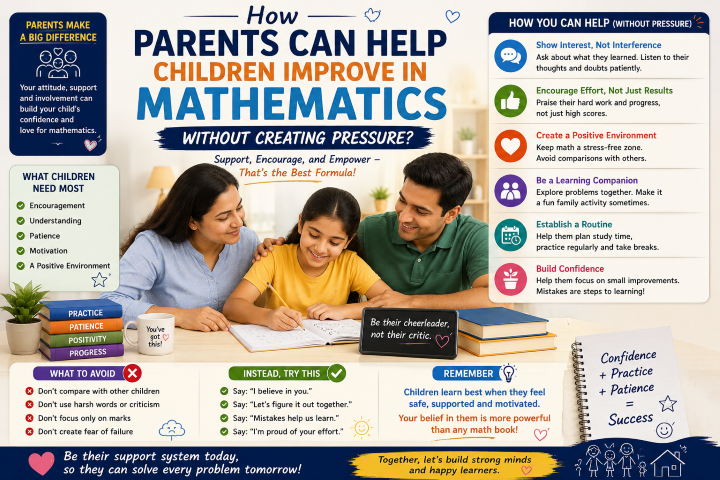
Mathematics can be an exciting subject for children, but it can also become a source of anxiety when learning is strongly associated with marks, comparison, punishment, or unrealistic expectations. Parents naturally want their children to succeed, yet excessive pressure can make children afraid of mistakes and reluctant to ask for help.
The most effective parental support is therefore not about turning the home into another classroom. It is about creating an environment where children feel safe to explore, make mistakes, ask questions, and gradually become confident in mathematics.
1. Focus on Understanding, Not Only Marks
One of the simplest ways parents can reduce pressure is to change the questions they ask.
Instead of repeatedly asking:
“How many marks did you get?”
parents can ask:
- “What did you learn today?”
- “Which question was interesting?”
- “Which part was difficult?”
- “Can you explain how you solved it?”
This shifts attention from performance alone to learning.
Marks are useful indicators, but they do not tell the entire story. A child may make progress in understanding even before the improvement appears in examination results.
2. Avoid Comparing Children
Every child develops mathematical skills at a different pace. Comparing one child with siblings, classmates, or neighbors can damage confidence.
Statements such as:
“Your friend is better at mathematics than you.”
may create fear rather than motivation.
Instead, encourage children to compare their current performance with their own previous performance.
For example:
“Last month you struggled with fractions, but now you can solve these problems independently.”
This encourages a growth-oriented attitude.
3. Make Mathematics Part of Everyday Life
Children do not need to study from a textbook every time they practice mathematics.
Parents can introduce mathematics naturally through everyday activities.
For example:
- Calculate shopping discounts.
- Measure ingredients while cooking.
- Estimate travel time.
- Compare prices.
- Count money.
- Calculate change.
- Read graphs and tables.
- Discuss sports statistics.
- Measure rooms or furniture.
- Plan a simple household budget.
These activities show children that mathematics is useful beyond examinations.
4. Encourage Children to Explain Their Thinking
When a child gives an answer, parents should sometimes ask:
“How did you get that answer?”
This is more valuable than immediately checking whether the answer is correct.
A child who explains their reasoning develops deeper mathematical understanding. Parents can also discover exactly where the child is confused.
If the answer is incorrect, avoid immediately saying:
“No, that’s wrong.”
Instead ask:
“Let’s look at your steps and see where the idea changed.”
This turns mistakes into learning opportunities.
5. Let Children Struggle Productively
When children face a difficult mathematics problem, parents may be tempted to provide the answer immediately.
However, too much help can prevent independent problem-solving.
Instead of giving the solution, provide small hints:
“What information do you already know?”
“Can you draw a picture?”
“Have you solved a similar problem before?”
“What would happen if you tried a smaller number?”
The aim is to help the child move forward without taking control of the problem.
6. Create a Calm Study Routine
Children benefit from a predictable learning routine, but the routine should not feel like punishment.
A short, regular mathematics practice session is often more effective than occasional hours of stressful study.
Parents can help children establish a comfortable study environment with:
- A quiet place
- Necessary materials
- Regular breaks
- Reasonable study periods
- Sufficient sleep
- Limited distractions
The goal should be consistency rather than excessive study time.
7. Praise Effort, Strategy, and Improvement
Parents should recognize more than correct answers.
Praise can focus on:
- Persistence
- Careful reasoning
- Improvement
- Trying a new method
- Correcting mistakes
- Asking thoughtful questions
Instead of saying:
“You are naturally good at mathematics.”
try:
“You kept trying different methods until you found one that worked.”
This teaches children that mathematical ability can develop through learning and practice.
8. Don’t Pass Mathematics Anxiety to Children
Parents sometimes unintentionally communicate negative attitudes toward mathematics.
Statements such as:
“I was never good at mathematics.”
or
“Mathematics is extremely difficult.”
can influence children’s beliefs about their own ability.
Parents do not need to pretend that mathematics is always easy. Instead, they can model a healthy attitude:
“This is difficult, but let’s see if we can understand it step by step.”
That message teaches persistence rather than fear.
9. Use Technology Carefully
Children today have access to educational applications, online lessons, calculators, videos, and AI tools. These resources can provide useful support.
However, technology should not become a shortcut for avoiding thinking.
If a child uses AI to solve a mathematics problem, parents can encourage them to ask:
“Do you understand why this method works?”
“Can you solve a similar problem without AI?”
“Can you explain the solution in your own words?”
The important issue is not whether children use technology, but whether technology strengthens or replaces their thinking.
10. Work With Teachers Rather Than Against Them
Parents and teachers have different but complementary roles.
If a child repeatedly struggles with a particular topic, parents should communicate with the teacher rather than simply increasing homework pressure at home.
Teachers can provide information about the child’s classroom performance, misconceptions, and appropriate learning strategies.
A supportive partnership between parents and teachers can help children receive consistent encouragement.
Current Situation: Increasing Competition and Educational Pressure
Today’s students often face considerable academic competition. Entrance examinations, scholarship opportunities, school assessments, and expectations surrounding future careers can make mathematics feel like a high-stakes subject.
At the same time, digital learning and AI have made educational resources more accessible. Children can now access explanations and practice materials almost instantly. However, the availability of more resources does not automatically mean better learning.
The challenge for parents is to avoid turning every available resource into another source of pressure.
The focus should remain on healthy learning habits, conceptual understanding, confidence, and gradual improvement.
Parents should also recognize signs that academic pressure may be becoming excessive, such as persistent fear of mathematics, avoidance, frequent frustration, or extreme worry about making mistakes. In such situations, reducing pressure and communicating with teachers or appropriate educational professionals may be more helpful than simply increasing study time.
A Simple “Support, Don’t Control” Approach
Parents can remember five simple principles:
Encourage: Show interest in the child’s learning.
Guide: Ask questions instead of immediately giving answers.
Practice: Use short and regular activities.
Accept: Treat mistakes as a normal part of learning.
Celebrate: Recognize progress rather than demanding perfection.
This approach allows parents to remain involved without taking away the child’s independence.
Conclusion
Parents play an important role in helping children develop mathematical confidence, but effective support does not require constant supervision or pressure.
The best home environment is one where children can ask questions without embarrassment, make mistakes without fear, and experience mathematics as something useful and meaningful.
Parents can help by connecting mathematics with daily life, encouraging explanation, providing gentle guidance, avoiding comparisons, supporting healthy routines, and using technology responsibly.
Most importantly, children need to know that their worth is not determined by a mathematics score.
The ultimate goal is not to create a child who is afraid of making mistakes but a learner who can say:
“I don’t understand this yet, but I can keep trying until I do.” That confidence is far more valuable than any single examination mark.