
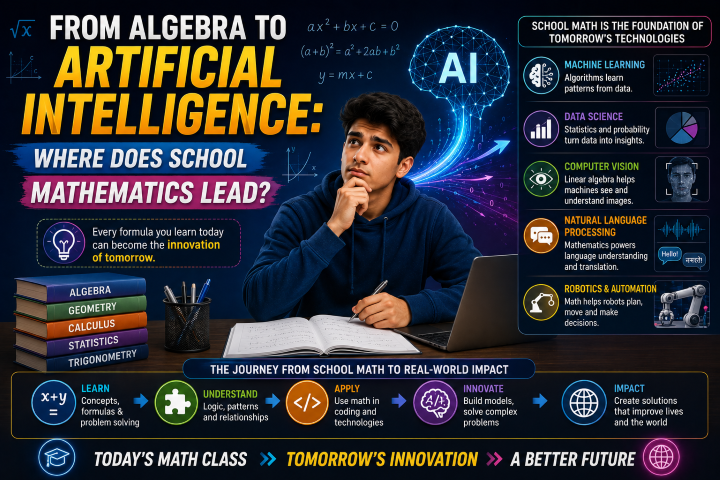
When students learn algebra, geometry, percentages, functions, probability, and statistics in school, they may wonder why they need to study so many mathematical ideas. A common question is, “Where will I use this in the future?” The answer becomes increasingly clear in today’s technology-driven world: school mathematics provides many of the fundamental ideas used in artificial intelligence, data science, robotics, engineering, computer science, and other advanced technologies.
Artificial intelligence may appear to be a completely modern invention, but beneath sophisticated AI systems are mathematical concepts that students encounter much earlier in their education. School mathematics does not automatically turn every student into an AI expert, but it builds the reasoning, numerical understanding, and problem-solving foundation needed to explore these fields.
Algebra: The Language of Relationships
Algebra teaches students how quantities relate to one another. Variables, equations, functions, and mathematical relationships are essential for understanding how computer systems represent and process information.
When students solve an equation such as:
2x + 5 = 15
they are learning more than how to find the value of x. They are learning how to represent an unknown quantity, manipulate relationships, and follow logical steps.
These ideas become increasingly sophisticated in computer science and AI. Mathematical models use variables to represent data, relationships, and predictions. In machine learning, systems adjust numerical parameters to improve their performance. The underlying principle—representing relationships mathematically—has roots in algebra.
Geometry: Understanding Space
Geometry is another school subject with powerful technological applications.
Robotics, computer graphics, computer vision, engineering, architecture, navigation systems, and game development all depend on geometric ideas.
When students learn about coordinates, angles, distance, shapes, and transformations, they are developing tools for understanding space.
For example, a robot moving through a room needs information about position, direction, and distance. A computer-generated image requires mathematical descriptions of shapes and locations. A navigation system needs to calculate relationships between points.
The geometry taught in school can therefore become a foundation for understanding how machines interact with physical and digital spaces.
Functions: Modeling the Real World
Functions are among the most important mathematical concepts connecting school mathematics with technology.
A function describes how one quantity changes in relation to another. Students may first encounter simple functions such as:
y = 2x + 3
Later, the same idea becomes more advanced in scientific computing, economics, engineering, statistics, and machine learning.
Many technological systems depend on mathematical functions to represent relationships and predict outcomes. Understanding functions helps students think about inputs, outputs, change, and patterns—ideas that are fundamental to computational modeling.
Probability: Teaching Machines About Uncertainty
The real world is full of uncertainty. A machine may need to determine whether an email is spam, whether an image contains a particular object, or how likely a particular event is to occur.
Probability provides the mathematical language for dealing with uncertainty.
School students may learn basic probability by calculating the chance of drawing a particular card or rolling a specific number on a die. At higher levels, probability becomes an essential component of statistics, machine learning, risk analysis, and AI.
Understanding probability also helps students become better consumers of information. They learn that a prediction is not always certain and that data must be interpreted carefully.
Statistics: Turning Data Into Knowledge
Artificial intelligence depends heavily on data, and statistics provides many of the tools needed to understand that data.
School statistics may begin with averages, percentages, graphs, and measures of spread. These concepts may seem simple, but they are foundational to data analysis.
Consider a dataset containing thousands of students’ examination results. Statistics can help identify average performance, differences between groups, trends over time, and unusual results.
In modern technology, statistical reasoning is used to evaluate models, identify patterns, understand uncertainty, and make predictions.
This is why data literacy is becoming increasingly important in education.
Calculus: Understanding Change
For students who continue mathematics to higher levels, calculus opens another important connection with technology.
Calculus provides tools for understanding continuous change, rates, optimization, and accumulation. These ideas are important in physics, engineering, economics, computer science, and many areas of machine learning.
Students may initially see differentiation and integration as abstract topics. However, these mathematical tools can eventually help describe how systems change and how certain quantities can be optimized.
The connection between mathematics and technology becomes particularly strong when students move from basic mathematical operations toward mathematical modeling.
Logical Thinking and Algorithms
School mathematics also develops something that cannot be reduced to a single formula: logical reasoning.
Computer programs work through instructions and logical conditions. Algorithms require clear sequences of steps for solving problems.
When students solve mathematical problems systematically, they are practicing a form of structured thinking that is useful in programming and computational problem-solving.
For example:
Understand the problem → identify information → choose a method → perform steps → check the result.
This approach resembles the logic used in designing algorithms.
Current Situation: Mathematics in the Age of AI
Artificial intelligence is developing rapidly, and AI tools are now accessible to students, teachers, professionals, and businesses. AI can generate text, analyze data, recognize images, write computer code, and solve mathematical problems.
This development raises an important educational question: If AI can perform calculations and solve equations, why should students learn mathematics?
The answer is that mathematical education is not only about calculation. It develops the ability to understand relationships, evaluate evidence, recognize patterns, question assumptions, and determine whether an answer makes sense.
AI can produce an answer, but students still need mathematical reasoning to evaluate that answer.
For example, if an AI system gives a statistical conclusion, a mathematically literate student can ask: What data was used? Is the sample representative? Is the conclusion reasonable? Could there be another explanation?
Thus, AI does not eliminate the importance of mathematics; it changes the skills students need to emphasize.
Mathematics and Future Careers
The connection between mathematics and technology creates opportunities across many careers.
Students with strong mathematical foundations can eventually explore fields such as:
- Artificial intelligence and machine learning
- Data science
- Software engineering
- Robotics
- Cybersecurity
- Computer graphics
- Engineering
- Financial technology
- Scientific research
- Statistics and analytics
Not every student needs to become a mathematician or programmer. However, mathematical literacy provides flexibility and opens doors to many future possibilities.
How Schools Can Prepare Students
Schools should move beyond teaching mathematics as a collection of formulas. Students should have opportunities to solve real-world problems, work with data, explore patterns, use technology responsibly, and explain their reasoning.
AI and digital tools can be incorporated into mathematics education, but students should be encouraged to attempt problems independently before using technology for assistance.
The ideal approach is not “mathematics versus technology.” It is “mathematics with technology.”
Technology can perform calculations quickly, visualize mathematical ideas, and provide feedback. Mathematics provides the reasoning needed to understand and evaluate what technology produces.
Conclusion
The journey from school algebra to artificial intelligence may seem enormous, but the connection is stronger than it first appears. Algebra teaches relationships, geometry teaches space, functions teach modeling, probability teaches uncertainty, statistics teaches data analysis, calculus teaches change, and mathematical problem-solving develops logical thinking.
These ideas form part of the intellectual foundation behind modern technology.
As artificial intelligence continues to transform education and employment, students should not study mathematics merely to pass examinations. They should learn it as a language of patterns, relationships, logic, and problem-solving.
The future may be powered by AI, robots, algorithms, and intelligent machines—but behind much of that technology is mathematics.From the simple equation written on a school blackboard to the complex models used by artificial intelligence, mathematics remains one of the essential bridges connecting human ideas with technological innovation.