

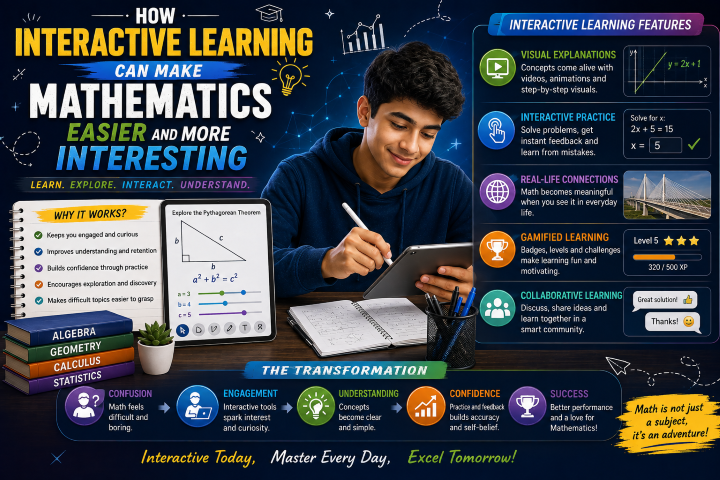
Mathematics has traditionally been taught through textbooks, lectures, formulas, and written exercises. While these methods remain valuable, many students find mathematics difficult because abstract ideas can be hard to visualize and classroom learning does not always match every student’s pace. Interactive learning offers a different approach. By allowing students to explore, manipulate, visualize, question, practice, and receive immediate feedback, educational technology can make mathematics more understandable and engaging.
Today, interactive learning includes digital simulations, educational games, virtual manipulatives, interactive quizzes, learning platforms, videos, graphing tools, and AI-supported tutoring. The important question is not whether technology should replace traditional mathematics teaching, but how technology can make mathematical thinking more active and meaningful.
1. From Watching to Doing
One of the biggest advantages of interactive learning is that students become active participants.
In a traditional lesson, a teacher might draw a graph on the board and explain how changing an equation affects its shape. With an interactive graphing tool, students can change the value of a variable themselves and immediately observe what happens.
For example, while studying:
y = ax + b
students can change a and b and watch how the graph moves or changes its slope.
Instead of simply remembering a rule, students can discover the relationship through experimentation.
2. Visualizing Abstract Mathematics
Many mathematical concepts are difficult because they cannot easily be seen.
Fractions, functions, geometry, transformations, probability, and three-dimensional shapes can become much easier when represented visually.
Interactive diagrams allow students to move points, change dimensions, rotate objects, and observe relationships. This is particularly useful for learners who struggle to understand mathematics from symbols alone.
Visualization does not replace mathematical notation. Instead, it helps students connect symbols, pictures, and real-world meaning.
3. Immediate Feedback
In traditional homework, students may complete several problems and only discover their mistakes when the teacher returns the work.
Interactive learning platforms can provide immediate feedback. If an answer is incorrect, students may receive a hint or be asked to try again.
Immediate feedback can prevent students from practicing the same mistake repeatedly. However, the best systems do more than say “wrong.” They help students understand why the answer is wrong.
This is especially valuable in mathematics, where one small error in an early step can affect the entire solution.
4. Learning at an Individual Pace
Students do not all learn mathematics at the same speed.
Some students may understand a concept after one explanation, while others need additional examples and practice. Interactive platforms can allow learners to repeat lessons, choose different difficulty levels, and receive additional questions.
A student who struggles with fractions can spend more time practicing fractions, while another student can move toward more challenging problems.
This creates a more personalized learning experience.
5. Making Practice More Engaging
Mathematics requires practice, but repetitive exercises can sometimes feel boring.
Educational games and interactive challenges can introduce elements such as goals, levels, immediate feedback, and problem-solving missions. When carefully designed, these features can encourage students to practice for longer periods.
However, games should not become entertainment without learning. A colorful interface is useful only when it supports mathematical thinking.
The goal should be:
Fun + Thinking + Practice = Meaningful Engagement
6. Real-World Applications
Interactive learning can connect mathematics to situations outside the classroom.
Students can use simulations to explore topics such as:
- Household budgeting
- Population growth
- Sports statistics
- Probability
- Interest and savings
- Travel distance and speed
- Construction and measurement
- Environmental data
For example, instead of simply learning percentages, students could explore how discounts, taxes, and interest affect the final price of a product.
This helps answer a question students frequently ask:
“Where will I use mathematics in real life?”
7. Collaboration and Communication
Interactive technology does not have to mean learning alone.
Students can work together on digital projects, compare solutions, discuss mathematical strategies, and explain their reasoning to classmates.
This is important because mathematics is not only about finding answers. Explaining why an answer is correct develops deeper understanding.
Collaborative digital activities can also help students learn that a problem may have multiple valid approaches.
8. Supporting Teachers
Interactive learning can benefit teachers as well as students.
Digital platforms can provide information about which questions students are getting wrong, which concepts require additional explanation, and which learners need support.
Teachers can use this information to adjust lessons rather than relying entirely on examination results.
However, technology should support teacher judgment, not replace it. A teacher understands classroom context, student emotions, misconceptions, and learning difficulties in ways that automated systems may not fully capture.
Current Situation: The Growth of EdTech and AI
Educational technology is developing rapidly. Students now have access to online classrooms, interactive mathematics applications, digital assessment systems, graphing software, and AI-powered learning tools.
The OECD’s recent work on digital education emphasizes that technology can support personalized learning and innovative teaching, but its educational value depends on how it is designed and used. Simply adding technology does not automatically improve learning.
The same principle applies to AI. An AI tutor can explain a difficult concept in several ways, generate practice questions, or provide hints. But if students simply ask AI for answers and copy them, technology may reduce rather than strengthen independent mathematical thinking.
Therefore, modern mathematics education needs purposeful technology use, not technology for its own sake.
9. Challenges of Interactive Learning
Despite its benefits, interactive learning has limitations.
Screen Dependence
Excessive screen time can create concentration problems. Students should have a healthy balance between digital and non-digital learning.
Distraction
A device that provides mathematics lessons can also provide games, social media, and entertainment. Students need self-discipline.
Unequal Access
Not every student has reliable internet, a personal device, or access to high-quality digital resources. Schools and policymakers must consider this digital divide.
Superficial Learning
Animations and games can make mathematics attractive without necessarily making it intellectually deeper. Educational design must prioritize understanding over visual effects.
Overdependence on Technology
Students still need to develop mental calculation, writing skills, logical reasoning, and the ability to solve problems without digital assistance.
How to Use Interactive Learning Effectively
A balanced mathematics lesson might follow this structure:
Explore → Explain → Practice → Discuss → Apply → Reflect
Students first explore a mathematical idea through an interactive activity. The teacher then explains the underlying concept. Students practice independently, discuss different approaches, apply the idea to a real-world problem, and finally reflect on what they learned.
This combines the strengths of technology with the strengths of traditional teaching.
Conclusion
Interactive learning can make mathematics more visual, engaging, personalized, practical, and understandable. It allows students to experiment with mathematical ideas rather than simply memorize rules. Immediate feedback can help identify mistakes, while simulations and digital tools can connect abstract concepts with real-world situations.
However, technology is not a magic solution. The success of EdTech depends on thoughtful teaching, appropriate digital tools, active student participation, and a strong focus on mathematical reasoning.
The future of mathematics education should not be teacher versus technology or traditional learning versus digital learning. It should be a thoughtful combination of both.When technology helps students explore ideas, ask better questions, understand mistakes, and think independently, mathematics stops being merely a collection of formulas and becomes an exciting subject to discover.