

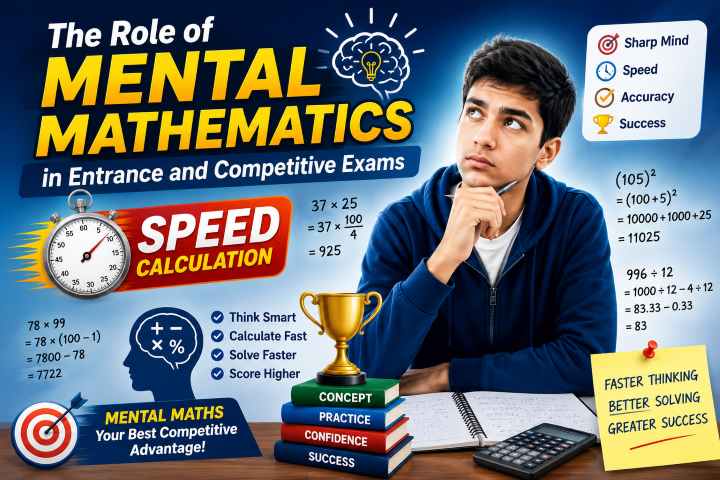
Mental mathematics is the ability to perform calculations in the mind, often without relying on a calculator, paper, or other external tools. In entrance and competitive examinations, this skill can become a significant advantage because students frequently face a large number of questions within a limited amount of time. Strong mental calculation does not replace conceptual understanding, but it can make mathematical problem-solving faster, more efficient, and more confident.
In competitive examinations, success depends on more than knowing formulas. Students must understand the question, select an appropriate method, calculate accurately, manage time, and make decisions under pressure. Mental mathematics supports several of these abilities simultaneously.
What Is Mental Mathematics?
Mental mathematics involves using logical strategies to perform calculations quickly in the mind. It includes skills such as adding and subtracting numbers efficiently, multiplying and dividing mentally, working with fractions and percentages, estimating values, recognizing numerical patterns, and simplifying calculations.
For example, instead of calculating (25 \times 48) through a long multiplication process, a student can think:
25 × 48 = 100 × 12 = 1200.
The answer is the same, but the method is faster and requires fewer written steps.
The goal is not simply to calculate quickly. Good mental mathematics means choosing an efficient calculation strategy.
Why Is Mental Mathematics Important in Competitive Exams?
1. It Saves Valuable Time
Time is one of the biggest challenges in entrance examinations. A student may understand every concept but still struggle to complete the paper if basic calculations take too long.
Mental calculation can reduce the time required for routine operations. Those saved seconds can accumulate across dozens of questions and provide additional time for more challenging problems.
2. It Improves Accuracy
At first, mental mathematics may seem mainly about speed, but it can also improve accuracy when practiced correctly. Students become more familiar with numbers and can recognize when an answer appears unreasonable.
For example, if a calculation should produce a value close to 500 but the student’s answer is 5,000, estimation can immediately signal that something went wrong.
Thus, mental mathematics is not only a tool for obtaining answers; it is also a checking mechanism.
3. It Strengthens Number Sense
Number sense means understanding how numbers relate to one another. Students with strong number sense can recognize useful relationships quickly.
For example:
- 50% = one-half
- 25% = one-quarter
- 10% = one-tenth
- 12.5% = one-eighth
Recognizing these relationships allows students to solve percentage problems without always relying on formal procedures.
Mental Mathematics and Entrance-Exam Strategy
Competitive examinations often contain questions where the main challenge is not the mathematics itself but choosing the fastest appropriate approach.
Consider:
48 × 25
Instead of traditional multiplication, recognize that 25 is one-quarter of 100:
48 × 25 = 48 × 100 ÷ 4 = 1200.
Similarly:
99 × 37 = (100 − 1) × 37 = 3700 − 37 = 3663.
These strategies reduce calculation time while maintaining mathematical reasoning.
Important Mental Calculation Skills
Students preparing for entrance examinations should develop several core skills.
Basic Arithmetic
Students should become comfortable with addition, subtraction, multiplication, and division. Strong familiarity with multiplication tables and common numerical relationships provides a foundation for faster calculation.
Fractions and Percentages
Fractions and percentages appear frequently in mathematics, economics, statistics, and aptitude questions. Students should quickly recognize common equivalents such as:
1/2 = 50%, 1/4 = 25%, 3/4 = 75%, 1/5 = 20%, and 1/10 = 10%.
Squares and Cubes
Knowing common squares and selected cubes can save time in algebra and numerical problems. Students can gradually memorize useful values rather than attempting to memorize an unnecessarily large list.
Estimation
Estimation is one of the most powerful mental-mathematics techniques. It allows students to approximate an answer before completing a calculation.
If the exact calculation gives a result dramatically different from the estimate, the student knows that the calculation should be checked.
Algebraic Shortcuts
Mental mathematics also involves recognizing algebraic patterns. For example:
(492 = (50-1)2
Using the identity:
gives:
2500 – 100 + 1 = 2401.
Recognizing such relationships can make difficult-looking calculations much easier.
How to Develop Mental Mathematics
Mental calculation is a skill that improves through regular practice rather than last-minute preparation.
Students can begin with 5–10 minutes of daily practice. Start with basic calculations and gradually introduce percentages, fractions, squares, estimation, ratios, and algebraic shortcuts.
Timed practice can also be useful, but students should not focus on speed alone. The correct order should be:
Understand → Calculate accurately → Develop shortcuts → Increase speed.
Students should also practice explaining why a shortcut works. This prevents mental mathematics from becoming another form of blind memorization.
The Role of Technology and AI
Today’s students have access to calculators, mobile applications, online practice platforms, and artificial intelligence tools. These technologies can provide instant calculations and explanations.
However, easy access to digital answers makes mental mathematics more—not less—valuable in some competitive settings. Students need to maintain independent numerical reasoning instead of becoming completely dependent on devices.
AI can be used productively by generating timed practice questions, identifying calculation errors, or explaining alternative strategies. But students should first attempt calculations independently and use technology afterward for verification.
The important principle is:
Use technology to extend your thinking, not to replace it.
Current Situation in Competitive Examinations
Modern entrance and competitive examinations increasingly emphasize application, reasoning, and problem-solving rather than simple recall. At the same time, candidates face strong competition and strict time limits.
This creates a situation where efficiency matters. Students who understand concepts but spend excessive time on routine calculations may find it difficult to complete all sections. On the other hand, students who calculate rapidly without understanding concepts may make serious mistakes.
Therefore, the most effective approach is a combination of conceptual understanding, mental calculation, accuracy, and examination strategy.
A Practical Daily Routine
Students can develop mental mathematics through a simple routine:
5 minutes: Basic arithmetic and multiplication.
5 minutes: Fractions, percentages, and ratios.
5 minutes: Squares, estimation, and numerical patterns.
5 minutes: Timed entrance-style questions.
After each session, students should review mistakes and identify which calculation strategy could have been more efficient.
Conclusion
Mental mathematics plays an important role in entrance and competitive examinations because it improves speed, numerical confidence, estimation, efficiency, and error detection. It allows students to spend less time on routine calculations and more time on questions that require deeper reasoning.
However, mental mathematics should never replace conceptual understanding. The strongest candidates combine both. They understand the mathematics deeply, recognize efficient strategies, calculate confidently, and know when a shortcut is appropriate.
In a competitive examination, every minute matters. A few seconds saved on one question may seem insignificant, but repeated across an entire paper, those seconds can make a meaningful difference. Ultimately, the goal is not simply to calculate faster. It is to think smarter, calculate efficiently, and solve problems with confidence under pressure.