

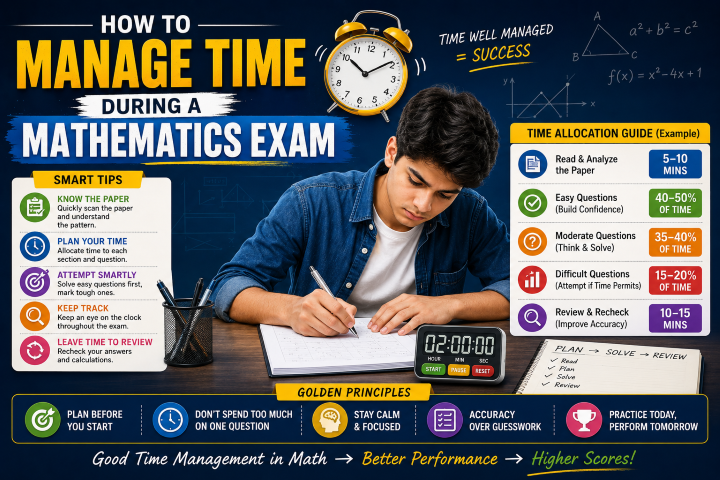
A mathematics examination is not only a test of knowledge and problem-solving ability; it is also a test of time management, concentration, accuracy, and decision-making. Many students understand the mathematics but lose marks because they spend too much time on difficult questions, rush through easy ones, or leave insufficient time for checking their answers. Effective exam technique can therefore make a significant difference between knowing the material and successfully demonstrating that knowledge.
Current assessment research shows that how students distribute their time across questions matters. The OECD has found that students tend to spend different amounts of time depending on question difficulty, while performance can decline toward the later parts of an assessment as fatigue and time pressure increase. (OECD) Therefore, students need a deliberate strategy rather than simply trying to solve questions as quickly as possible.
1. Know Your Exam Before Entering the Hall
Good time management begins before the examination. Students should know the total duration, number of questions, question types, marks allocated to different sections, and whether there is negative marking.
For example, if an examination lasts two hours and contains 60 questions, students should have a rough idea of how much time can be spent on each section. However, this does not mean dividing the total time equally among every question. Difficult questions naturally require more time, while easy questions should be completed quickly.
The goal is to create a flexible time budget, not a rigid timetable.
2. Read the Instructions Carefully
When the examination begins, do not immediately start calculating. Spend a short amount of time reading the instructions carefully.
Check:
- How many questions must be attempted?
- Are all questions compulsory?
- Is there negative marking?
- Are calculators allowed?
- Are there separate sections?
- How much time is available?
A few minutes spent understanding the paper can prevent much larger mistakes later.
3. Scan the Paper Strategically
Before becoming deeply involved in the first difficult problem, quickly scan the examination.
Identify questions that appear:
Easy: Familiar and likely to be solved quickly.
Moderate: Require some thinking but are manageable.
Difficult: Unfamiliar, lengthy, or likely to consume substantial time.
Start with questions you can solve confidently. This builds momentum and secures marks early.
4. Do Not Spend Too Long on One Question
One of the biggest time-management mistakes is becoming emotionally attached to a difficult question.
A student may spend ten or fifteen minutes trying to solve one problem because they believe they are “almost there.” Meanwhile, several easier questions remain unanswered.
Set a personal time limit. If you have made little progress after a reasonable amount of time, mark the question, move forward, and return later.
Skipping temporarily is not giving up. It is a strategic decision.
5. Use the Easy–Moderate–Difficult Strategy
A useful examination strategy is to work in three rounds.
Round One: Easy Questions
Solve questions that require familiar formulas, straightforward calculations, or simple reasoning. Avoid unnecessary checking unless something looks suspicious.
Round Two: Moderate Questions
Return to questions requiring more calculation or thought. By now, you have already secured many marks and can concentrate more calmly.
Round Three: Difficult Questions
Use the remaining time for challenging problems. Try different approaches, eliminate impossible options, and use logical reasoning.
This strategy reduces the risk of spending most of the examination on a small number of difficult questions.
6. Show Your Working Clearly
In mathematics, writing steps is not only useful for teachers; it can also help students manage their own thinking.
Writing important steps clearly reduces confusion in multi-stage problems. If you make an error, you can identify where it occurred instead of restarting the entire problem.
For subjective examinations, clear working may also allow partial credit when the final answer is incorrect but the method contains valid mathematical reasoning.
7. Develop Calculation Efficiency
Time management is closely connected with mathematical fluency. Students who struggle with basic arithmetic, algebraic manipulation, fractions, percentages, or standard formulas naturally require more time.
Regular practice can improve this efficiency.
However, speed should not mean careless calculation. A useful principle is:
Calculate efficiently, not recklessly.
Estimation can also help. If you know that the answer should be approximately 50, a result such as 5,000 immediately signals that something may have gone wrong.
8. Leave Time for Checking
Students often make the mistake of using every available minute for solving new questions and leaving no time for review.
Whenever possible, reserve the final 5–15 minutes, depending on the examination length, for checking.
Focus on:
- Unanswered questions
- Negative signs
- Decimal points
- Units
- Formula substitutions
- Arithmetic mistakes
- Incorrectly marked options
- Answers that appear unreasonable
Do not automatically change an answer simply because you are nervous. Change it when you have a clear mathematical reason.
9. Manage Anxiety and Mental Fatigue
Time management is not only about the clock. It is also about managing your mental energy.
Mathematics requires concentration, and anxiety can interfere with that concentration. Research discussed by the OECD shows that mathematics and test-related anxiety can make it harder for students to focus on mathematical tasks. (OECD)
If you become stuck or anxious, pause briefly. Take a slow breath, reread the question, and identify one piece of information you understand. A calm mind often solves a problem more efficiently than a rushed mind.
10. Practice Time Management Before the Exam
Time management cannot be mastered by reading advice on the morning of an examination. It must be practiced.
Take regular mock examinations under realistic conditions. Use the actual time limit and avoid unnecessary interruptions.
After each mock test, record:
- Number of questions attempted
- Number correct
- Number incorrect
- Time spent on difficult questions
- Questions left unanswered
- Types of mistakes made
Then adjust your strategy.
Self-monitoring is an important part of effective learning. Recent OECD work highlights the value of students actively monitoring their understanding and adjusting their learning strategies. (OECD)
Current Situation: Digital Exams and New Challenges
Mathematics assessment is increasingly influenced by digital technology. Online tests, computer-based assessments, digital calculators, and other tools can change how students interact with questions. Modern assessment frameworks increasingly emphasize mathematical reasoning and the ability to apply mathematics to real-world problems, rather than simply recalling procedures. (OECD)
Digital environments also create new distractions. OECD data indicate that distraction from other students’ use of digital devices is associated with mathematics performance, showing that effective concentration remains important even when technology is part of learning. (OECD)
Therefore, students should practice not only mathematical skills but also digital concentration, self-monitoring, and strategic decision-making when preparing for modern assessments.
A Simple Time-Management Formula
Students can remember the following strategy:
Read → Scan → Solve → Skip → Return → Check
Read the instructions carefully.
Scan the paper and identify question difficulty.
Solve easy and familiar questions first.
Skip questions that consume excessive time.
Return to moderate and difficult questions later.
Check your work before submitting.
This simple sequence can prevent many common examination mistakes.
Conclusion
Effective time management during a mathematics examination does not mean solving every question as quickly as possible. It means using limited time intelligently.
Students should understand the examination format, scan the paper, begin with manageable questions, avoid spending too long on one problem, maintain calculation accuracy, control anxiety, and reserve time for checking. Regular mock tests can turn these techniques into habits.
The most successful examination strategy is not simply “work faster.” It is:
“Know when to work, when to move on, when to return, and when to check.”
When mathematical knowledge is combined with smart time management, students can enter the examination with greater confidence and make their limited time work in their favor.