
Mathematics is often associated with classrooms, textbooks, formulas, and examinations. Many students wonder, “When will I ever use this in real life?” The surprising answer is: we use mathematics every day, often without even realizing it. From checking the time in the morning to planning a journey, shopping for groceries, managing money, cooking food, or using a smartphone, mathematical thinking quietly guides many of our decisions.
Practical mathematics is not always about solving complicated equations. It is about using numbers, measurements, patterns, logic, estimation, and relationships to make everyday activities easier and more accurate.
1. Mathematics Begins With Time
One of the simplest examples of practical mathematics is managing time. We calculate how long it takes to get ready, how much time remains before school or work, and how long a journey will take.
When someone says, “I need 30 minutes to get ready and 45 minutes to travel,” they are already using mathematical reasoning to decide when to leave home.
Creating a daily schedule also involves addition, subtraction, comparison, and estimation. Effective time management is therefore a practical application of mathematics.
2. Shopping and Discounts
Shopping is one of the most common situations where mathematics is used.
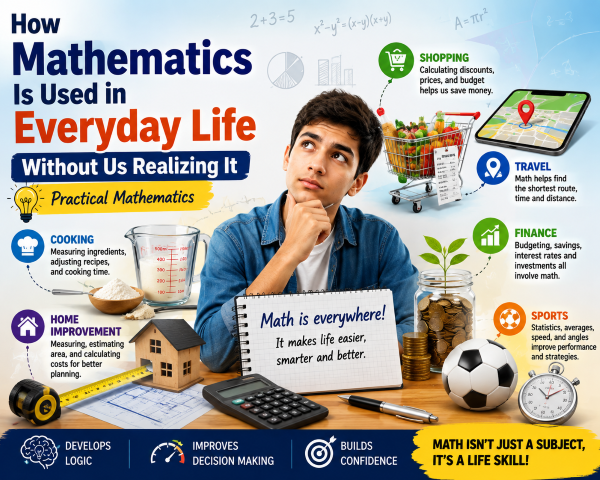
When a product is advertised with a 20% discount, customers need to calculate how much money they will save and what the final price will be. Comparing two products may also require calculating price per kilogram, litre, or unit.
For example, a large package may appear cheaper, but calculating the cost per unit can reveal which product actually provides better value.
Understanding percentages and ratios helps consumers make better financial decisions.
3. Managing Money and Budgets
Every household uses mathematics to manage money. People calculate income, expenses, savings, bills, loans, interest, and monthly budgets.
Suppose a person earns a fixed monthly income and must divide it among food, transportation, education, housing, savings, and entertainment. This requires planning, percentages, subtraction, and estimation.
Digital banking and mobile payments have made financial transactions easier, but they have not eliminated the need for mathematical understanding. In fact, the ability to understand interest rates, fees, discounts, and financial statements is increasingly important.
4. Cooking and Measurements
Cooking is another everyday activity filled with mathematics.
Recipes use measurements such as grams, kilograms, millilitres, cups, teaspoons, and tablespoons. If a recipe is designed for four people but you need to prepare food for eight, you must multiply the quantities.
Similarly, reducing a recipe requires division. Temperature, cooking time, ratios, and proportions also involve mathematical thinking.
A good cook may not consciously think, “I am applying mathematics,” but mathematics is present throughout the process.
5. Travel and Transportation
Planning a journey involves several mathematical ideas.
We estimate distance, calculate travel time, compare transportation costs, and consider speed and fuel consumption. A driver may need to determine whether there is enough fuel for a particular distance. A passenger may compare the cost and duration of different transportation options.
Maps and navigation applications also rely heavily on mathematical models to calculate distances, routes, directions, and estimated arrival times.
6. Mathematics in Sports
Sports provide many examples of practical mathematics. Players, coaches, and fans regularly use scores, averages, percentages, rankings, distances, speeds, and probabilities.
In cricket, for example, run rates and required run rates involve mathematical calculations. In football, statistics such as possession percentages and shooting accuracy help analyze performance.
Even deciding how much time remains in a game requires basic arithmetic and time calculation.
7. Home Improvement and Construction
Mathematics becomes especially important when measuring or modifying a home.
Painting a room requires calculating wall area to estimate how much paint is needed. Buying flooring requires measuring length and width and calculating area. Furniture must fit within specific dimensions.
Construction workers and architects use much more advanced mathematics, but the basic principles of measurement, geometry, ratios, and estimation are also used by ordinary people at home.
8. Health and Fitness
Mathematics also appears in health and fitness.
People may track steps, calories, exercise duration, body measurements, heart rate, or progress over time. Doctors and health professionals use statistics, measurements, probabilities, and dosage calculations.
Even comparing changes in weight or calculating exercise goals involves percentages and basic arithmetic.
Understanding numbers can help people interpret health information more responsibly.
9. Technology and Social Media
Modern digital life depends heavily on mathematics.
Search engines, online shopping recommendations, GPS systems, digital payments, computer graphics, artificial intelligence, and social media platforms all rely on mathematical models and algorithms.
When a navigation application calculates the fastest route or a streaming service recommends a video, mathematical processes are operating behind the scenes.
Although users may never see the equations, mathematical reasoning is part of the technology they use every day.
10. Making Decisions
Perhaps the most important everyday use of mathematics is decision-making.
Should you buy a product now or wait for a discount? Is a loan affordable? Which travel option is cheaper? How much food should be prepared? How much money should be saved each month?
These decisions involve comparing quantities, estimating outcomes, evaluating probabilities, and considering trade-offs.
Mathematics gives people a structured way to make decisions rather than relying entirely on guesswork.
Current Situation: Mathematics in a Digital and AI-Driven World
Today, technology can perform many calculations instantly. Smartphones have calculators, applications can convert units, and AI tools can solve complicated mathematical problems within seconds.
This might make mathematics appear less important. However, the opposite is often true. When technology provides an answer, people still need to understand whether the answer is reasonable.
For example, an AI system or online calculator may produce a numerical result, but users need basic mathematical knowledge to identify incorrect inputs, unrealistic results, or misleading statistics.
The growing influence of AI therefore makes practical mathematical literacy increasingly valuable. People do not necessarily need to perform every calculation manually, but they need to understand numbers well enough to interpret and question the results.
Why Practical Mathematics Matters
Practical mathematics helps people become more independent. A person who understands percentages can evaluate discounts. Someone who understands interest can make better financial decisions. A person who understands measurement can plan household projects. Someone who understands statistics can interpret information more critically.
These skills are useful regardless of occupation.
Practical mathematics also reduces dependence on others. Instead of accepting a number simply because someone provides it, mathematically literate people can check, compare, estimate, and make their own decisions.
Conclusion
Mathematics is not limited to classrooms and examinations. It is present in time management, shopping, budgeting, cooking, transportation, sports, construction, health, technology, and everyday decision-making.
The most interesting part is that we often use mathematics without consciously thinking about it. We estimate, compare, measure, calculate, and recognize patterns naturally as part of daily life.
In today’s digital and AI-driven world, practical mathematics is becoming even more important. Technology may perform calculations for us, but human beings still need to understand numbers, interpret information, and make sensible decisions. Ultimately, mathematics is not just something we study in school. It is a practical language we use every day to understand the world, solve problems, manage resources, and make better decisions.