
A good mathematics teacher does much more than explain formulas, solve textbook exercises, and prepare students for examinations. Mathematics is a subject of reasoning, patterns, creativity, and problem-solving, so effective mathematics teaching must help students think mathematically, not merely remember mathematical procedures.
In today’s rapidly changing educational environment, this role has become even more important. Students have access to YouTube lessons, online courses, calculators, educational applications, and artificial intelligence. A teacher is no longer the only source of information. Instead, the teacher’s greatest value lies in helping students understand information, ask meaningful questions, develop confidence, recognize mistakes, and apply mathematics intelligently.
1. A Good Teacher Builds Understanding
A strong mathematics teacher does not begin and end with the question, “Which formula should we use?”
Instead, the teacher asks:
- Why does this formula work?
- When should we use it?
- Can we solve the problem another way?
- What happens if one condition changes?
- How does this concept connect with previous learning?
For example, rather than simply asking students to memorize the formula for the area of a triangle, a teacher can demonstrate how the triangle relates to a rectangle or parallelogram.
When students understand the reasoning behind a formula, they are more likely to remember it and apply it correctly in unfamiliar situations.
2. A Good Teacher Makes Difficult Ideas Accessible
Mathematical concepts can sometimes appear abstract and intimidating. A good teacher breaks complex ideas into manageable parts without making them intellectually weak.
Different students may understand the same concept through different representations. One student may prefer diagrams, another may understand through numerical examples, and another may need a real-world application.
Effective teachers therefore use multiple approaches:
Concrete example → Visual representation → Mathematical language → Abstract concept
This gradual movement from familiar experiences to formal mathematics can make difficult topics easier to understand.
3. A Good Teacher Encourages Questions
A classroom where students are afraid to ask questions cannot become a strong mathematical learning environment.
Students should feel comfortable saying:
“I don’t understand.”
They should also feel encouraged to ask:
“Why?” “What if?” “Is there another method?”
These questions are not signs of weakness. They are signs of mathematical curiosity.
A good teacher treats mistakes and questions as opportunities for learning rather than reasons for embarrassment.
4. A Good Teacher Uses Mistakes as Learning Opportunities
Mathematical errors are valuable sources of information.
Instead of simply saying, “That answer is wrong,” an effective teacher asks:
“Where did the reasoning change?”
Suppose a student makes an algebraic mistake while solving an equation. The teacher can examine the student’s steps and identify the misunderstanding.
This approach develops error analysis and helps students become independent learners who can diagnose their own mistakes.
5. A Good Teacher Develops Problem-Solving Skills
Real mathematical ability cannot be measured only by how many formulas students remember.
A good teacher gives students problems that require them to:
- Identify relevant information
- Develop a strategy
- Test ideas
- Make connections
- Explain reasoning
- Evaluate solutions
Students should occasionally encounter problems where the method is not immediately obvious.
This develops persistence and prepares them for real-life situations where problems rarely come with a formula attached.
6. A Good Teacher Connects Mathematics With Real Life
Students often ask, “Where will I use this?”
A good teacher helps answer that question.
Percentages can be connected with discounts, taxes, and financial planning. Statistics can be connected with news and sports. Geometry can be connected with construction and design. Probability can be connected with games, risk, and decision-making.
Real-world examples help students understand that mathematics is not simply an examination subject. It is a tool for interpreting and solving problems in everyday life.
7. A Good Teacher Balances Speed and Understanding
In competitive educational environments, speed is important. Students may need to solve many questions within a limited period.
However, teaching students to solve everything as quickly as possible can encourage careless mistakes and superficial understanding.
A strong teacher develops mathematics in stages:
Understanding → Accuracy → Efficiency → Speed
Students first learn why a method works, then practice it accurately, and finally learn how to apply it efficiently.
8. A Good Teacher Uses Technology Wisely
Technology has transformed mathematics education. Digital graphing tools, interactive simulations, online assessments, educational videos, and AI-based learning systems can make mathematics more visual and personalized.
But technology should serve a learning purpose.
For example, a graphing application can allow students to change parameters and observe how a function behaves. An AI tutor can provide a hint when a student is stuck.
However, if students simply copy AI-generated solutions, they may complete assignments without developing mathematical thinking.
A good teacher therefore teaches students how to use technology without becoming dependent on it.
9. A Good Teacher Understands Individual Differences
Not every student learns mathematics in the same way or at the same speed.
Some students may have strong calculation skills but weak conceptual understanding. Others may understand concepts well but struggle with examination pressure. Some may need additional practice, while others need more challenging problems.
Effective teachers observe these differences and provide appropriate support.
The goal is not necessarily to give every student exactly the same learning experience. It is to provide every student with an appropriate opportunity to progress.
10. A Good Teacher Builds Mathematical Confidence
One of the greatest barriers to mathematics learning is the belief:
“I am just not good at mathematics.”
A good teacher challenges this mindset.
Students need to understand that mathematical ability can develop through practice, reflection, and persistence. Difficulty should not automatically be interpreted as inability.
Praise should focus not only on correct answers but also on good reasoning, persistence, improvement, and effective strategies.
Confidence does not mean convincing students that every problem is easy. It means helping them believe:
“Even if this problem is difficult, I can work through it.”
Current Situation: The Changing Role of Mathematics Teachers
Education is currently experiencing major changes because of digital technology and artificial intelligence. Students can obtain explanations and solutions instantly, meaning teachers are increasingly moving from being the primary source of information toward becoming learning designers, mentors, facilitators, and critical-thinking guides.
Recent OECD work emphasizes that generative AI can support education when used with clear pedagogical purpose, but it can also create risks when it simply produces completed work without strengthening students’ knowledge or thinking.
This makes the teacher’s role more important, not less.
A mathematics teacher must help students distinguish between getting an answer and understanding an answer. They must teach students to question AI-generated solutions, verify calculations, and explain mathematical reasoning independently.
The modern mathematics classroom should therefore combine human guidance with appropriate technology.
11. A Good Teacher Is Also a Lifelong Learner
Mathematics teaching methods continue to evolve. New technologies, assessment systems, research findings, and educational approaches are constantly emerging.
An effective teacher continues learning.
They experiment with different teaching methods, reflect on student performance, collaborate with colleagues, and remain open to improvement.
The best teachers are not those who claim to know everything. They are those who are willing to learn alongside their students.
Conclusion
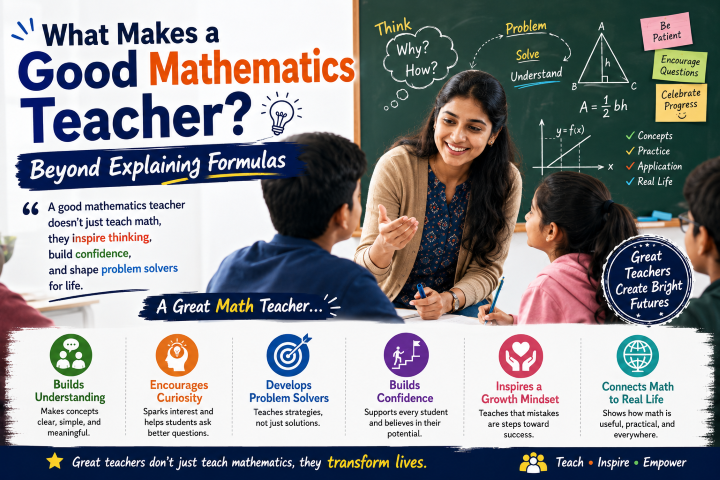
A good mathematics teacher is much more than someone who can explain formulas clearly. A truly effective teacher builds understanding, encourages questions, values mistakes, develops problem-solving skills, connects mathematics with real life, uses technology responsibly, supports different learners, and builds confidence.
In the modern classroom, students can find information almost anywhere. What they need from a teacher is something deeper: guidance in how to think.
The ultimate goal of mathematics teaching should not simply be to produce students who can calculate correctly. It should produce students who can reason logically, solve unfamiliar problems, learn from mistakes, question assumptions, and use mathematics confidently in real life. A formula may help a student solve one problem. But a good teacher can help that student develop a way of thinking that lasts a lifetime.