

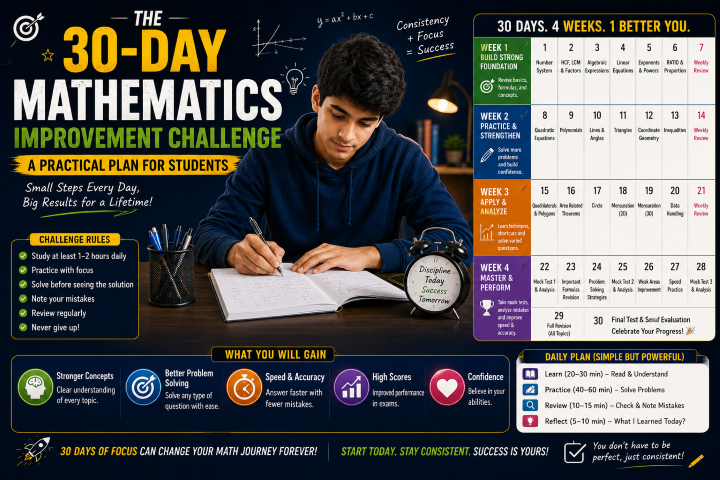
Improving mathematics does not always require studying for long hours. What matters more is consistent practice, correct strategy, error analysis, and gradual improvement. Many students study mathematics only when examinations are approaching. This often creates stress and encourages memorization rather than genuine understanding.
A better approach is to build a daily habit.
The 30-Day Mathematics Improvement Challenge is designed to help students develop stronger mathematical understanding, better problem-solving skills, greater accuracy, and improved examination confidence. The plan can be adapted for school students, entrance-exam candidates, and learners who simply want to strengthen their foundations.
The basic principle is simple:
Learn → Practice → Analyze → Improve → Repeat.
Why a 30-Day Challenge?
Thirty days is long enough to establish a consistent study routine while being short enough to maintain motivation.
The purpose is not to become a mathematics expert in one month. Instead, the goal is to create measurable improvement.
By the end of 30 days, students should aim to:
- Strengthen weak concepts
- Reduce repeated mistakes
- Improve calculation speed
- Develop problem-solving strategies
- Increase accuracy
- Become more comfortable with difficult questions
- Build a regular mathematics habit
Even 45–60 minutes of focused practice each day can produce meaningful progress when used effectively.
Week 1: Build the Foundation
Day 1: Find Your Starting Point
Begin with a short diagnostic test covering different topics.
Do not worry about the score.
The purpose is to identify what you know and what you do not know.
After the test, divide your mistakes into three categories:
Concept mistake | Calculation mistake | Careless mistake
This becomes your starting point.
Day 2: Identify Your Weak Topics
Review recent tests, assignments, and homework.
Choose three topics that need the most attention.
For example:
- Algebra
- Geometry
- Percentages
- Trigonometry
- Statistics
Do not try to fix everything at once.
Day 3: Review Basic Concepts
Choose your weakest topic and review the fundamental ideas.
Do not simply memorize formulas. Ask:
What does this concept mean?
Why does the method work?
When should I use it?
Day 4: Basic Practice
Solve 15–20 straightforward questions from the same topic.
Focus on accuracy rather than speed.
Day 5: Moderate Questions
Increase the difficulty.
Try questions that require two or more steps.
If you make a mistake, record it rather than simply checking the answer and moving on.
Day 6: Error Analysis
Review all mistakes from the first five days.
Create an Error Notebook with four columns:
| Question | Mistake | Reason | Correct Approach |
This notebook will become one of your most useful study tools.
Day 7: Weekly Test
Take a 30–45-minute test covering the week’s topics.
Afterward, spend at least as much time analyzing mistakes as you spent taking the test.
Week 2: Strengthen Problem-Solving
The second week focuses on moving from knowing mathematics to using mathematics.
Day 8: Learn Multiple Methods
Take five problems you already know how to solve.
Try to find alternative methods.
This develops flexibility.
Day 9: Word Problems
Practice converting words into mathematical expressions.
Ask:
What information is given?
What is unknown?
What relationship connects them?
Day 10: Pattern Recognition
Practice sequences, number patterns, algebraic relationships, and logical problems.
The goal is to recognize structure rather than calculate mechanically.
Day 11: Mixed Practice
Instead of solving 20 questions from one chapter, solve 20 questions from different topics.
This is more difficult because you must first decide which mathematical method to use.
Day 12: Difficult Questions
Choose five challenging problems.
Give yourself enough time to struggle before looking for help.
Try at least two approaches before checking a solution.
Day 13: Explain Your Solutions
Choose three problems and explain the complete solution aloud or in writing as if you were teaching someone else.
If you cannot explain a step clearly, you may not fully understand it yet.
Day 14: Weekly Test
Take another timed test.
Compare your results with Day 7.
Do not focus only on the score. Check whether your type of mistakes has changed.
Week 3: Speed and Accuracy
Mathematical knowledge is important, but students also need to solve problems efficiently, especially in entrance and competitive examinations.
Day 15: Mental Mathematics
Practice:
- Multiplication
- Division
- Fractions
- Percentages
- Squares
- Estimation
Spend 10–15 minutes on mental calculation.
Day 16: Calculation Accuracy
Solve 20 routine questions slowly and carefully.
Your objective is zero careless errors.
Day 17: Timed Practice
Choose 15 questions and set a strict time limit.
Record:
Questions attempted | Correct answers | Incorrect answers | Time used
Day 18: Learn Shortcuts
Study useful mathematical shortcuts and identities.
But do not memorize shortcuts blindly. Understand why they work and when they should be used.
Day 19: Speed vs. Accuracy
Take two short tests.
In the first, prioritize accuracy.
In the second, prioritize speed.
Compare the results.
The objective is to find a balance rather than becoming extremely fast and careless.
Day 20: Review Your Error Notebook
Look for repeated mistakes.
If you have made the same error three or four times, it is not a random mistake anymore. It is a weakness that needs targeted practice.
Day 21: Weekly Mock Test
Take a longer test under examination conditions.
No phone.
No unnecessary breaks.
No solution checking during the test.
Afterward, conduct detailed error analysis.
Week 4: Exam-Level Thinking
The final week combines everything you have learned.
Day 22: Unfamiliar Problems
Solve questions you have never seen before.
Avoid immediately searching for solutions.
Ask:
What do I know?
What am I being asked to find?
Which concepts might be connected?
Day 23: Problem-Solving Strategies
Practice techniques such as:
- Drawing diagrams
- Working backward
- Estimation
- Substitution
- Simplification
- Breaking a problem into smaller parts
- Checking extreme cases
Day 24: Weakest Topic Day
Return to the topic that still causes the most difficulty.
Spend the entire session repairing that weakness.
Day 25: Teach Mathematics
Teach one topic to a friend, sibling, parent, or even an imaginary student.
Teaching forces you to organize your thoughts and identify gaps in understanding.
Day 26: Technology-Assisted Learning
Use an educational application, graphing tool, online resource, or AI tutor strategically.
Do not simply ask for answers.
Instead ask:
“Give me a hint.”
“Find the first mistake in my solution.”
“Give me a similar problem.”
This keeps you actively involved in the learning process.
Day 27: Full Mock Examination
Take a complete mathematics test under realistic conditions.
Treat it as the real examination.
Day 28: Deep Analysis
Spend considerable time analyzing the mock test.
Classify every lost mark:
Concept | Calculation | Carelessness | Time | Question selection
This tells you what to improve next.
Days 29–30: Measure Your Progress
Day 29: Repeat the Diagnostic Test
Take a test similar to the one you completed on Day 1.
Compare:
- Accuracy
- Completion time
- Number of attempts
- Conceptual understanding
- Repeated mistakes
- Confidence
Your improvement may not appear only as a higher score. You may also discover that you solve questions more independently or make fewer mistakes.
Day 30: Build Your Long-Term Plan
The challenge ends, but your mathematics journey does not.
Write down:
Three things I improved
Three weaknesses I still have
Three habits I will continue
For example:
- 45 minutes of mathematics practice daily.
- Weekly timed tests.
- Maintaining an error notebook.
The Daily 60-Minute Formula
If you have only one hour each day, use this structure:
10 minutes — Mental mathematics
15 minutes — Concept learning
25 minutes — Problem-solving
10 minutes — Error analysis/review
The exact timing can be adjusted according to your level and examination requirements.
The key is to avoid spending the entire hour simply reading solutions.
Current Situation: Learning in the Digital and AI Era
Students today have access to more mathematical resources than ever before. Online courses, video lessons, interactive platforms, digital question banks, calculators, and AI tools can provide immediate assistance.
But greater access to information does not automatically produce better learning.
One of the biggest challenges today is passive dependence on technology. Students may obtain an instant solution without developing the ability to solve a similar problem independently.
AI and digital tools should therefore be used as learning assistants, not replacement thinkers.
A useful rule is:
Try first → Ask for a hint → Solve independently → Check the solution → Practice again.
This approach allows technology to support learning while preserving independent mathematical thinking.
What If You Miss a Day?
Do not quit.
The purpose of the challenge is consistency, not perfection.
If you miss Day 12, simply continue with Day 12 the next day. Avoid trying to complete several days’ work at once.
A single missed day is not failure.
Giving up completely is the real problem.
The Most Important Rule
Do not measure success only by marks.
At the end of 30 days, ask:
Can I understand difficult questions more confidently?
Can I identify my own mistakes?
Can I solve unfamiliar problems?
Can I explain mathematical ideas clearly?
Can I work under time pressure without panicking?
If the answer to these questions is increasingly “yes,” you are making genuine progress.
Conclusion
The 30-Day Mathematics Improvement Challenge is not about studying mathematics for endless hours. It is about creating a structured, active, and measurable learning routine.
The most important habits are simple:
Practice every day.
Understand concepts.
Solve independently.
Analyze mistakes.
Work on weak areas.
Measure progress.
Keep going.
Mathematical ability is not something that develops overnight. It grows through repeated effort, reflection, and intelligent practice.
You do not need to become perfect in 30 days.
You simply need to become better than you were on Day 1. And if you continue the habits developed during these 30 days, that improvement can become the beginning of much stronger mathematical performance in school, entrance examinations, and real-life problem-solving.