

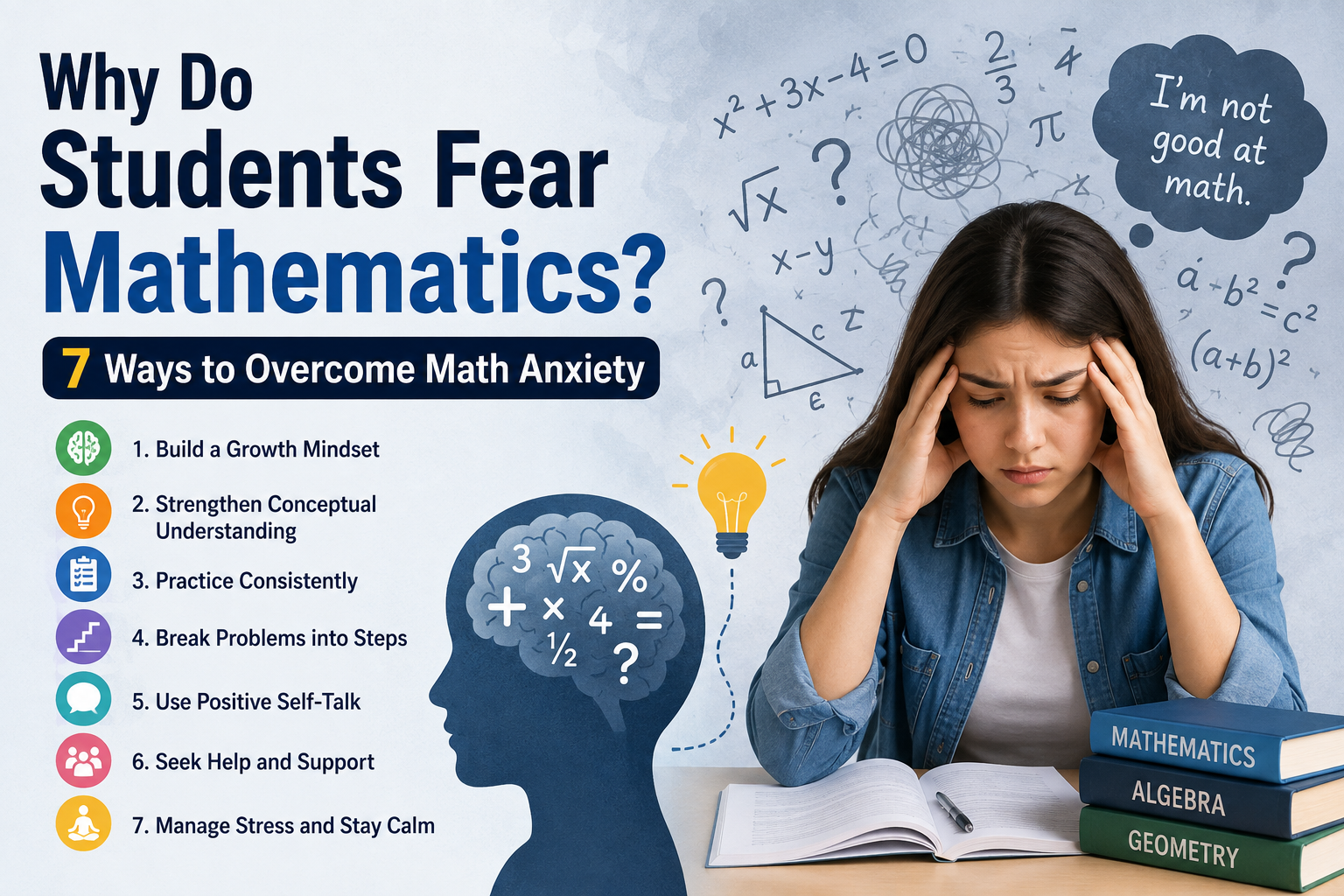
Mathematics is often described as a subject of logic, numbers, and problem-solving. Yet for many students, simply seeing a mathematics question can create nervousness, confusion, or even fear. Some students say, “I am not a mathematics person,” while others experience anxiety before tests, avoid difficult problems, or lose confidence after making mistakes.
This fear is commonly called math anxiety—a feeling of tension, worry, or fear that interferes with mathematical learning or performance. It is important to understand that math anxiety is not the same as being incapable of learning mathematics. A student can have strong mathematical potential while still experiencing anxiety.
The good news is that math anxiety can be reduced. With the right learning environment, practice, mindset, and support, students can gradually replace fear with confidence.
1. Understand Where the Fear Comes From
Math anxiety can develop for many reasons.
A student may have experienced repeated failure, harsh criticism, negative comparisons, examination pressure, or an embarrassing experience in the classroom. Sometimes children also absorb negative attitudes from adults who say things such as:
“I was never good at mathematics.”
Such messages can make students believe that mathematical ability is something people either have or do not have.
In reality, mathematical ability develops through learning and practice.
The first step in overcoming anxiety is therefore to recognize:
Difficulty does not mean inability.
2. Stop Thinking That Mistakes Mean Failure
Mathematics requires mistakes.
A student who never makes mistakes may simply be solving problems that are too easy. Mistakes provide information about what needs to be understood.
Instead of thinking:
“I got the answer wrong, so I am bad at mathematics.”
think:
“This mistake shows me what I need to learn.”
Students can maintain an error notebook where they record the problem, their mistake, its cause, and the correct approach.
Over time, this transforms errors from sources of embarrassment into tools for improvement.
3. Break Difficult Problems Into Smaller Steps
Large mathematical problems can appear frightening when students try to solve everything at once.
A better approach is to ask:
What information is given?
What am I being asked to find?
Which concept is relevant?
What is the first step?
Students do not need to know the entire solution immediately.
They only need to identify the next reasonable step.
This reduces mental pressure and makes complex problems feel manageable.
4. Practice Regularly Instead of Cramming
Studying mathematics for many hours immediately before an examination can increase anxiety.
Regular, shorter practice sessions are generally more effective.
For example, a student might spend 30–60 focused minutes each day reviewing concepts and solving problems.
A useful routine is:
Understand → Practice → Check → Correct → Repeat
Regular practice also increases familiarity. As students encounter similar mathematical structures repeatedly, questions that once seemed frightening become more recognizable.
5. Replace Comparison With Personal Progress
Comparing yourself with classmates can make mathematics anxiety worse.
One student may solve a problem in two minutes while another needs ten minutes. That does not automatically mean the first student will always be better.
Instead, compare yourself with your previous performance.
Ask:
Did I make fewer mistakes this week?
Can I solve a problem today that I couldn’t solve last month?
Am I becoming faster without losing accuracy?
Progress is a better measure than comparison.
6. Use Breathing and Positive Self-Talk
Math anxiety is not only a thinking problem; it can also produce physical symptoms such as increased heart rate, tension, or difficulty concentrating.
Before an examination or difficult problem, students can take a few slow breaths and deliberately reduce the pressure they place on themselves.
Instead of:
“I must solve everything perfectly.”
try:
“I will solve one question at a time.”
Instead of:
“I am terrible at mathematics.”
try:
“This problem is difficult, but I can work through it step by step.”
This may sound simple, but changing internal language can help students approach problems more calmly.
7. Ask for Help Without Feeling Ashamed
Struggling with mathematics is not something students should hide.
A good teacher can identify misconceptions and explain concepts differently. Parents can provide encouragement without creating pressure. Classmates can offer alternative ways of thinking.
Students can also use online resources and AI tools responsibly.
Instead of asking an AI system:
“Give me the answer.”
a student can ask:
“I tried this problem and got stuck at this step. Can you give me a hint without solving it for me?”
This encourages learning rather than dependency.
The Role of Teachers in Reducing Math Anxiety
Teachers have a major influence on students’ attitudes toward mathematics.
A classroom focused entirely on speed, marks, and correct answers can make anxious students feel even more pressured.
A supportive mathematics classroom should encourage:
- Questions
- Multiple solution methods
- Reasoning
- Productive mistakes
- Discussion
- Gradual improvement
- Conceptual understanding
Teachers should avoid humiliating students for incorrect answers.
Instead of asking only:
“What is the answer?”
teachers can ask:
“How did you think about the problem?”
This changes the classroom from an answer-focused environment into a reasoning-focused environment.
The Role of Parents
Parents can either reduce or increase mathematics anxiety.
Constantly asking about marks, comparing children with others, or expressing disappointment over mistakes may increase pressure.
A more supportive approach is to ask:
“What part did you find difficult?”
“How can we practice that together?”
“What did you learn from your mistake?”
Parents should celebrate improvement rather than demand perfection.
Most importantly, children should know that their value is not determined by a mathematics score.
Current Situation: Mathematics Anxiety in a Changing Educational Environment
Students today face intense academic competition, frequent assessments, entrance examinations, and pressure to perform well in mathematics and science-related subjects.
At the same time, technology has dramatically changed how mathematics can be learned. Students can access video lessons, interactive applications, online practice platforms, calculators, and AI-based tutors almost instantly.
These resources can be helpful, but they can also create a new problem: information overload.
Students may jump from one explanation to another without developing a consistent learning strategy. AI can also provide solutions so quickly that students may avoid the productive struggle needed to build confidence.
The goal should therefore not be to eliminate all difficulty from mathematics. Instead, students need to learn how to manage difficulty without becoming overwhelmed.
Math Anxiety Is Not a Permanent Identity
One of the most important things students should understand is that math anxiety does not define their mathematical ability.
A student may be anxious today and confident six months from now.
A student who struggles with algebra today may eventually become comfortable with advanced mathematics.
The transformation usually begins with small experiences of success.
Solve one problem.
Then another.
Understand one concept.
Correct one mistake.
Complete one practice test.
These small achievements gradually build confidence.
A Simple Anti-Anxiety Routine
Before studying mathematics:
1 minute: Take slow breaths.
5 minutes: Review a familiar concept.
20 minutes: Solve problems independently.
10 minutes: Work on one challenging question.
5 minutes: Review mistakes.
End the session by identifying one thing you improved.
This creates a positive association with mathematical learning.
Conclusion
Mathematics anxiety is real, but it does not have to control a student’s future.
Fear often grows from repeated failure, negative beliefs, comparison, pressure, and lack of confidence. It can be reduced through regular practice, supportive teaching, realistic goals, error analysis, positive self-talk, and gradual exposure to challenging problems.
The most important change is to stop seeing mathematics as a test of whether you are “naturally smart.”
Mathematics is a skill that develops.
You do not have to be fearless to become good at mathematics. You only need to become comfortable taking the next step even when a problem feels difficult.
With patience, practice, and the right support, fear can gradually become familiarity, familiarity can become confidence, and confidence can become genuine mathematical ability.