
Mathematics is often considered a difficult subject, but the real challenge is usually not the subject itself—it is the way students study it. Effective mathematics learning requires more than memorizing formulas. It involves understanding concepts, practicing regularly, learning from mistakes, and developing the confidence to solve unfamiliar problems.
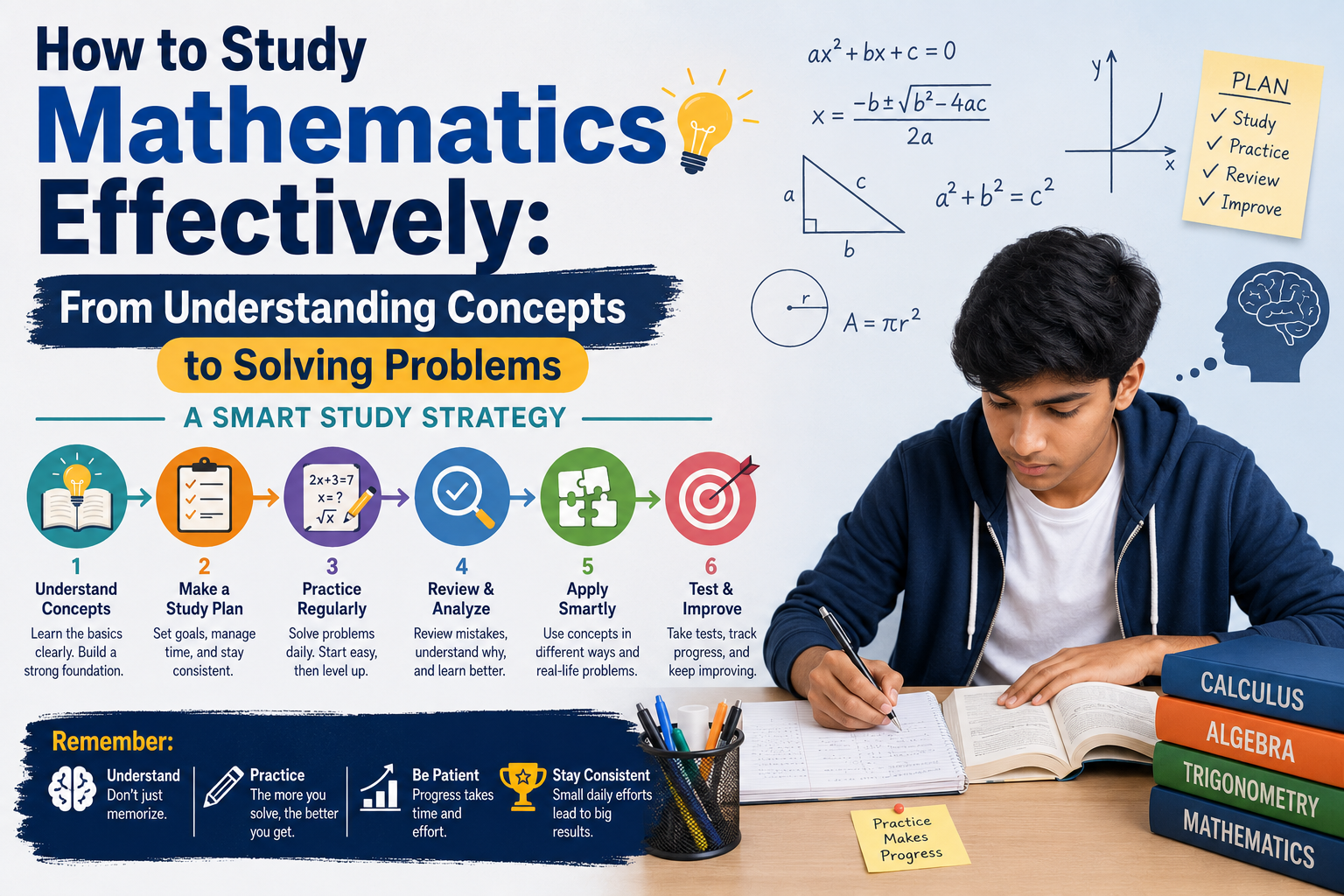
The first step is to understand the concept before memorizing the formula. Students should ask why a formula works, what each symbol represents, and where it can be applied. For example, instead of simply memorizing the quadratic formula, a learner should understand the relationship between the formula, the quadratic equation, and its graphical meaning. Connecting new ideas with previously learned concepts makes mathematics easier to remember and apply.
The second important strategy is regular, spaced practice. Studying mathematics for several hours immediately before an examination may produce short-term familiarity, but it is less effective for long-term learning. A 2025 meta-analysis found that spaced practice produced a small-to-medium advantage over concentrated practice in mathematics learning. Therefore, students should study mathematics in shorter sessions throughout the week rather than relying on last-minute revision.
Students should also solve problems actively. Reading worked examples is useful when learning a new method, but eventually learners must attempt problems without looking at the solution. Recent research indicates that problem-solving after initial learning can lead to better long-term performance than simply studying examples. A useful routine is: understand an example, close the book, solve a similar problem independently, and then compare the solution.
Another powerful technique is retrieval practice. Instead of repeatedly reading notes, students can close their books and try to recall formulas, definitions, procedures, and previous problem-solving steps. Research published in 2025 found evidence that retrieval practice can support mathematics learning, while spaced practice showed particularly consistent benefits.
The current situation of mathematics education is also changing because of artificial intelligence. AI tools can provide instant solutions, explanations, and personalized assistance. However, using AI simply to obtain answers can weaken independent reasoning and create an illusion of understanding. Current discussions in education increasingly emphasize using AI as a tutor or source of hints while keeping the actual reasoning and problem-solving in the student’s hands.
Finally, students should learn from mistakes rather than fear them. After every incorrect answer, they should identify whether the problem was caused by a conceptual misunderstanding, calculation error, incorrect strategy, or careless reading. Keeping a small “mistake notebook” can reveal repeated weaknesses and guide future revision.
In conclusion, effective mathematics study is a combination of understanding, spaced practice, retrieval, independent problem-solving, reflection, and responsible use of technology. In an age when AI can produce answers instantly, genuine mathematical understanding is more valuable than ever. The goal should not be merely to get the correct answer, but to understand why the answer is correct and to develop the ability to solve the next problem independently.
नेपालीमा
गणितलाई प्रभावकारी रूपमा कसरी अध्ययन गर्ने: अवधारणा बुझाइदेखि समस्या समाधानसम्म
गणित धेरै विद्यार्थीका लागि कठिन विषय मानिन्छ। तर गणित वास्तवमै कठिनभन्दा पनि यसलाई अध्ययन गर्ने तरिका प्रभावकारी हुन आवश्यक हुन्छ। गणितमा राम्रो गर्न सूत्रहरू मात्र कण्ठ गर्नु पर्याप्त हुँदैन। अवधारणा बुझ्ने, नियमित अभ्यास गर्ने, आफ्ना गल्तीबाट सिक्ने र नयाँ प्रकारका समस्याहरू समाधान गर्ने क्षमता विकास गर्नु आवश्यक हुन्छ।
सबैभन्दा पहिले सूत्र कण्ठ गर्नुभन्दा अवधारणा बुझ्नुपर्छ। कुनै सूत्र किन प्रयोग हुन्छ, त्यसका प्रत्येक चिन्ह वा संख्याले के जनाउँछन् र त्यसलाई कहाँ प्रयोग गर्न सकिन्छ भन्ने कुरा बुझ्नुपर्छ। उदाहरणका लागि, द्विघात समीकरणको सूत्र कण्ठ गर्नु मात्र पर्याप्त हुँदैन; उक्त सूत्रले समीकरणका मूलहरू कसरी पत्ता लगाउँछ भन्ने कुरा पनि बुझ्नुपर्छ। नयाँ अवधारणालाई पहिले सिकेका विषयसँग जोडेर अध्ययन गर्दा ज्ञान लामो समयसम्म सम्झन सजिलो हुन्छ।
दोस्रो महत्त्वपूर्ण उपाय नियमित र अन्तराल राखेर अभ्यास गर्नु हो। परीक्षाको केही दिनअघि धेरै घण्टा पढ्नुभन्दा प्रत्येक दिन थोरै समय गणित अभ्यास गर्नु बढी प्रभावकारी हुन्छ। हालैका शैक्षिक अध्ययनहरूले पनि अन्तराल राखेर गरिने अभ्यासले गणित सिकाइमा सकारात्मक प्रभाव पार्ने देखाएका छन्। त्यसैले विद्यार्थीले दैनिक वा साप्ताहिक अध्ययन तालिका बनाएर नियमित रूपमा अभ्यास गर्नुपर्छ।
त्यसैगरी, समस्या आफैं समाधान गर्ने बानी विकास गर्नुपर्छ। उदाहरण वा समाधान पढेर मात्र गणित सिकिँदैन। नयाँ विधि बुझिसकेपछि पुस्तक बन्द गरेर त्यस्तै प्रकारको प्रश्न आफैं समाधान गर्ने प्रयास गर्नुपर्छ। उत्तर गलत भए पनि निराश हुनु हुँदैन। प्रयास गर्दा नै समस्या समाधान गर्ने क्षमता र तार्किक सोच विकास हुन्छ।
अर्को प्रभावकारी प्रविधि आफूले सिकेको कुरा सम्झेर दोहोर्याउने अभ्यास हो। नोट पटक–पटक पढ्नुको सट्टा पुस्तक बन्द गरेर सूत्र, परिभाषा वा समाधान गर्ने प्रक्रिया सम्झने प्रयास गर्नुपर्छ। यसले स्मरणशक्ति बलियो बनाउँछ र परीक्षाको समयमा आवश्यक जानकारी छिटो सम्झन सहयोग गर्छ।
वर्तमान समयमा गणित अध्ययनमा प्रविधि र कृत्रिम बुद्धिमत्ता (AI) को प्रयोग पनि बढिरहेको छ। AI तथा अनलाइन शैक्षिक साधनहरूले कठिन प्रश्नको व्याख्या, उदाहरण र संकेत उपलब्ध गराउन सक्छन्। तर AI बाट सिधै उत्तर लिएर कपी गर्नु प्रभावकारी अध्ययन होइन। यसको सट्टा AI लाई शिक्षक वा सहायकको रूपमा प्रयोग गर्दै “यो उत्तर किन सही हो?”, “यो चरण कसरी आयो?” जस्ता प्रश्न सोध्नु उपयोगी हुन्छ। अन्ततः समस्या आफैं समाधान गर्ने क्षमता विद्यार्थीले नै विकास गर्नुपर्छ।
अन्तमा, गल्तीबाट सिक्ने बानी गणित अध्ययनको महत्वपूर्ण पक्ष हो। गलत उत्तर आएपछि त्यसको कारण पत्ता लगाउनुपर्छ—अवधारणा नबुझेको हो, गणना गलत भएको हो, सूत्र गलत प्रयोग गरिएको हो वा प्रश्न राम्रोसँग नपढिएको हो? यस्ता गल्तीहरूलाई छुट्टै कापीमा लेखेर पुनः अभ्यास गर्दा कमजोरी क्रमशः सुधार हुँदै जान्छ। निष्कर्षमा, गणित प्रभावकारी रूपमा अध्ययन गर्न अवधारणा बुझ्ने, नियमित अभ्यास गर्ने, सम्झेर दोहोर्याउने, समस्या आफैं समाधान गर्ने, गल्तीबाट सिक्ने र प्रविधिको सही प्रयोग गर्ने बानी आवश्यक हुन्छ। आज AI ले केही सेकेन्डमै उत्तर दिन सक्ने अवस्थामा पनि वास्तविक गणितीय ज्ञान र तार्किक सोचको महत्त्व अझ बढेको छ। त्यसैले गणित पढ्नुको उद्देश्य केवल सही उत्तर निकाल्नु होइन, उत्तर किन र कसरी सही भयो भन्ने बुझ्नु तथा नयाँ समस्या आफैं समाधान गर्न सक्षम हुनु हो।