
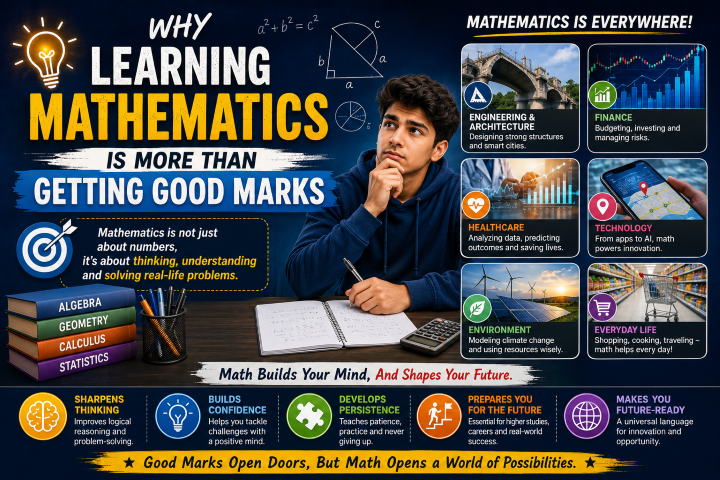
Mathematics is often associated with examinations, homework, formulas, and marks. For many students, the question “How many marks did you get?” seems more important than “What did you learn?” But mathematics is much more than a subject designed to produce high scores. It develops ways of thinking that remain valuable long after an examination is over. From managing money and interpreting information to making decisions and understanding technology, mathematics is deeply connected with everyday life.
Mathematics Develops Logical Thinking
One of the greatest benefits of learning mathematics is the development of logical thinking. Mathematical problems require students to examine information, identify relationships, follow logical steps, and reach conclusions based on evidence.
When students solve an equation or prove a geometric statement, they learn that conclusions should be supported by reasoning rather than assumptions. This habit of logical thinking can be applied to many areas of life.
For example, when comparing different products, evaluating information online, or deciding between financial options, a person needs to examine evidence and think carefully. Mathematical reasoning helps develop this ability.
Mathematics Teaches Problem-Solving
Life rarely presents problems in the exact form found in a textbook. Real-world challenges are often incomplete, complicated, and unpredictable.
Mathematics teaches students to break large problems into smaller parts, identify what is known, determine what is missing, consider possible strategies, and evaluate the result.
These skills are useful whether someone is planning a journey, managing a household budget, designing a building, analyzing business data, or solving a technical problem.
A student may forget a particular formula years after graduation, but the problem-solving habits developed through mathematics can remain useful throughout life.
Financial Literacy Depends on Mathematics
Everyday financial decisions involve mathematics. People calculate discounts, interest, loans, taxes, savings, investments, budgets, and expenses.
A person who understands percentages can recognize whether a discount is genuinely beneficial. Someone who understands compound interest can better appreciate how savings and debt grow over time.
In a world where financial products and digital payments are increasingly common, basic mathematical understanding is an important part of financial independence.
Mathematics Helps Us Understand Data
We live in an age of information. News reports, social media, advertisements, government publications, and businesses constantly present numbers, percentages, graphs, and statistics.
Without basic mathematical literacy, people can easily misunderstand or be misled by data.
For example, a statement such as “sales increased by 50%” may sound impressive, but understanding the original number is essential for interpreting the actual change. Similarly, averages, percentages, probabilities, and graphs can influence how people understand health, economics, education, sports, and public policy.
Mathematics therefore helps citizens become more informed and critical consumers of information.
Mathematics and Technology
Modern technology is deeply connected with mathematics. Computer science, engineering, artificial intelligence, data science, cybersecurity, architecture, and many other fields depend on mathematical ideas.
Even when people are not professional mathematicians, they interact with mathematical systems every day. Search engines, navigation applications, online recommendations, digital banking, and many forms of artificial intelligence depend on algorithms and mathematical models.
Understanding basic mathematical ideas can therefore help students become more confident users of technology and better prepared for future careers.
Mathematics Encourages Creativity
Mathematics is sometimes described as a purely logical subject, but it also involves creativity. Many mathematical problems can be solved in multiple ways. Students may discover patterns, develop shortcuts, create models, or find elegant solutions.
When a student asks, “Can I solve this in another way?” they are engaging in creative thinking.
This combination of logic and creativity is valuable in science, engineering, business, design, research, and entrepreneurship.
Mathematics Builds Persistence
Difficult mathematical problems often cannot be solved immediately. Students may need to try several approaches before finding the correct one.
This experience teaches persistence. Students learn that failure is not necessarily the end of the process; it can provide information about what to try next.
Such resilience is valuable far beyond mathematics. Academic study, professional work, entrepreneurship, and personal challenges all require the ability to continue after an initial failure.
Current Situation: Mathematics in an AI-Driven World
The role of mathematics is changing as artificial intelligence becomes increasingly available. AI systems can calculate, generate equations, explain procedures, and produce solutions within seconds. This may lead some students to question why they need to learn mathematics when technology can do the calculations for them.
However, the rise of AI makes mathematical understanding even more important in certain ways. Students need to judge whether an AI-generated answer is reasonable, identify incorrect assumptions, interpret data, and understand the logic behind a solution.
If a person cannot understand the mathematical structure of a problem, it becomes difficult to determine whether an automated answer is reliable.
Therefore, the purpose of mathematics education should increasingly focus on reasoning, interpretation, problem-solving, and mathematical literacy, rather than calculation alone.
Mathematics Is Not Only for Mathematics Careers
Another common misconception is that mathematics is useful only for engineers, scientists, accountants, or mathematicians. In reality, mathematical thinking is valuable in almost every profession.
Doctors interpret statistics and medical data. Teachers analyze student performance. Business owners calculate costs and profits. Journalists interpret surveys and research. Architects use geometry. Programmers rely on algorithms and logic. Even artists and designers may use proportions, patterns, symmetry, and measurement.
The level of mathematics required may differ, but the underlying skills—reasoning, analysis, estimation, and problem-solving—are widely applicable.
The Real Meaning of Success in Mathematics
Getting good marks is certainly valuable. Strong academic performance can open opportunities for further study and competitive examinations. However, marks should be viewed as one measure of learning, not the purpose of learning itself.
A student who scores highly by memorizing formulas but cannot apply mathematical ideas to real situations may have achieved short-term success. A student who understands concepts, asks questions, reasons logically, learns from mistakes, and applies mathematics to unfamiliar problems is developing deeper and more lasting knowledge.
The best mathematics education combines both achievement and understanding.
Conclusion
Learning mathematics is more than preparing for examinations. It is an investment in logical thinking, problem-solving, financial awareness, data literacy, technological understanding, creativity, and resilience.
Marks may tell us how a student performed on a particular examination, but they cannot fully measure how mathematics has shaped the student’s ability to think.
In today’s rapidly changing and increasingly data-driven world, mathematical literacy is becoming more important, not less. Even when calculators and AI can perform complicated calculations instantly, people still need to ask the most important questions:
Does this answer make sense? Why is it correct? What does the information really mean? And how should I use it to make a good decision? That is why the true value of mathematics lies not merely in getting good marks, but in learning how to think, how to solve problems, and how to understand the world more intelligently.