
Artificial intelligence has entered education at remarkable speed. Students can now ask an AI system to explain an equation, generate practice questions, identify mistakes, or provide step-by-step guidance within seconds. For mathematics in particular, AI appears extremely useful because it can respond to questions individually and offer explanations at different levels of difficulty.
But an important question remains: Does getting an answer from AI mean that a student has actually learned mathematics?
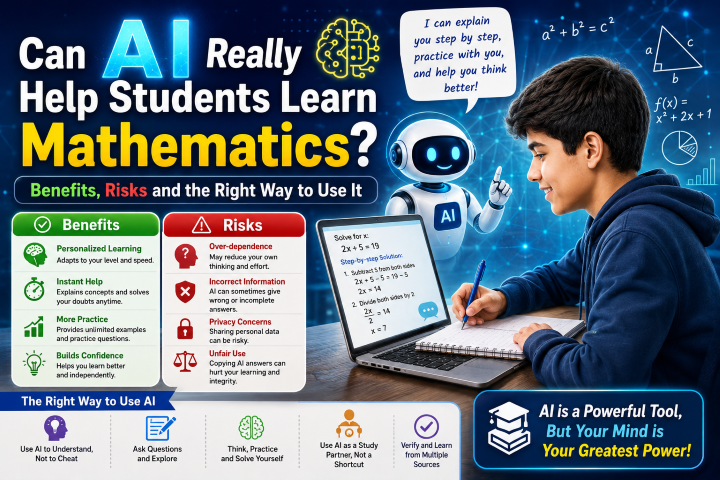
The answer is not necessarily. AI can become a powerful mathematics learning partner when used correctly, but it can also become a shortcut that prevents students from thinking. Current evidence increasingly suggests that the difference lies not simply in whether students use AI, but how they use it and for what educational purpose. The OECD’s 2026 Digital Education Outlook reports that general-purpose AI can improve students’ immediate task performance without necessarily producing lasting learning gains, while more purposeful educational uses show greater promise.
AI as a Personal Mathematics Tutor
One of the greatest advantages of AI is personalized assistance.
In a traditional classroom, one teacher may have to support dozens of students at the same time. A student who does not understand quadratic equations may have to wait until the next class to ask for help. An AI tutor, by contrast, can provide an explanation immediately.
Students can ask:
- “Explain this equation step by step.”
- “Give me a simpler example.”
- “Why is my answer wrong?”
- “Give me another problem of the same type.”
- “Don’t give me the answer; just give me a hint.”
This flexibility can make mathematics less intimidating and allow students to learn at their own pace.
Research and current OECD initiatives are also exploring AI-powered mathematics tutoring and feedback systems designed specifically to support learning rather than merely produce answers.
AI Can Make Practice More Effective
Practice is essential in mathematics, but students often run out of suitable questions. AI can generate additional problems based on a student’s level.
For example, after learning percentages, a student can request:
“Give me five beginner questions, five intermediate questions, and five difficult entrance-style questions.”
AI can also create variations of the same problem. This is valuable because true understanding requires students to recognize a mathematical idea even when the numbers or wording change.
However, students should attempt the problems themselves before asking AI for solutions.
AI Can Help Identify Mistakes
Perhaps one of the most educational uses of AI is error analysis.
Instead of asking, “What is the answer?”, students can provide their working and ask:
“Find the first step where my reasoning went wrong and explain why.”
This approach encourages students to examine their own thinking.
For mathematics learners, understanding why an answer is wrong is often more valuable than simply seeing the correct answer.
The Biggest Risk: AI Doing the Thinking
The greatest danger is overdependence.
If a student immediately sends every difficult homework problem to AI, copies the solution, and submits it, the student may complete the assignment without developing mathematical understanding.
The OECD’s 2026 research highlights this concern: students using general-purpose GenAI may produce better-quality work while not necessarily developing corresponding learning gains. In some studies, the advantage disappeared or even reversed when students later had to perform without AI.
Mathematics requires productive struggle. Getting stuck, trying another method, making an error, and correcting it are part of learning.
If AI removes all the struggle, it can also remove some of the learning.
AI Can Sometimes Be Wrong
Another important problem is reliability.
AI systems can produce answers that sound convincing but contain incorrect calculations, flawed reasoning, or fabricated information. The OECD specifically identifies inaccuracies and fabricated information as risks associated with generative AI in education. (OECD)
This is particularly important in mathematics because a polished explanation can still contain a subtle error.
Therefore, students should develop the habit of checking AI-generated solutions by:
- Recalculating the answer.
- Substituting the result back into the equation.
- Comparing it with a textbook or teacher’s method.
- Asking AI to explain each step.
- Checking whether the final answer is reasonable.
The student should remain the final judge of correctness.
AI and the Future of Mathematics Education
The current situation is changing the role of both students and teachers. AI is increasingly being incorporated into educational discussions, while schools and education systems are developing policies around responsible use, privacy, assessment, academic integrity, and AI literacy. OECD data show that AI use among teachers is already significant, while many teachers also express concerns about students presenting AI-generated work as their own.
The future is therefore unlikely to be simply “AI versus traditional education.” A more realistic model is AI + teacher + student.
Teachers remain important for motivation, judgment, emotional support, classroom interaction, and understanding individual students. AI can provide additional explanations, practice, feedback, and personalized assistance.
The goal should be to use AI to strengthen the teacher-student relationship rather than replace it.
The Right Way to Use AI for Mathematics
A simple “Attempt–Hint–Solve–Check” approach can make AI much more useful.
1. Attempt
Try the problem independently first. Write down what you know and develop a possible method.
2. Hint
If you are stuck, ask AI for a small hint, not the complete solution.
3. Solve
Use the hint to continue solving the problem yourself.
4. Check
After finishing, ask AI to review your reasoning and identify mistakes or alternative methods.
This approach keeps the student’s brain at the center of the learning process.
Students should also sometimes practice mathematics without AI. Foundational knowledge must become independent knowledge, especially because examinations may restrict or prohibit AI assistance. OECD guidance emphasizes that students need sufficient subject knowledge and independent thinking to evaluate AI outputs effectively.
AI Should Support Thinking, Not Replace It
The most valuable question is not:
“Can AI solve this mathematics problem?”
Of course, AI can solve many problems.
The better question is:
“Can AI help me become better at solving mathematics problems myself?”
That is where responsible AI use becomes educationally meaningful.
AI can explain concepts, generate practice, provide hints, analyze errors, and offer alternative approaches. But students still need to develop calculation skills, logical reasoning, mathematical intuition, persistence, and independent problem-solving ability.
Conclusion
Artificial intelligence has enormous potential to transform mathematics education. It can make learning more personalized, accessible, interactive, and responsive. However, its benefits depend heavily on how students use it.
Using AI to copy answers may improve today’s homework score but weaken tomorrow’s mathematical ability. Using AI to ask questions, receive hints, analyze mistakes, practice new problems, and challenge one’s understanding can make it a powerful learning partner.
Current evidence supports this balanced approach: AI works best when its use has a clear educational purpose and when it encourages active engagement rather than replacing students’ cognitive effort.
The future of mathematics education should therefore not be about choosing between human learning and artificial intelligence. It should be about teaching students to use powerful technology without giving up their own ability to think.The best use of AI in mathematics is not to make students dependent on answers, but to help them become independent problem-solvers.